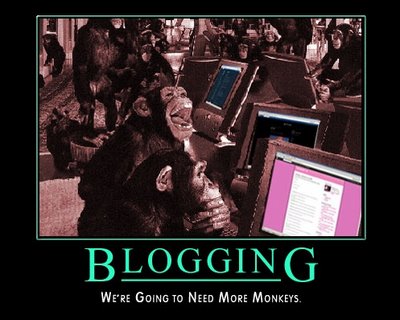
Monday, March 31, 2008

Selling out?

Habitual readers may be interested in knowing that I will soon be joining the ranks of Newstex, a blog syndication service that aggregates content and sells it to legal information services such as LexisNexis, EBSCO, CanWest MediaWorks, Thomson Financial, and Thomson Business Intelligence.

I am quite chuffed by their invitation for many reasons. Firstly, this means that I might actually get paid for blogging (granted, it will just be enough to buy me a cup of coffee, but the thought is nice). Secondly, it is a service offered through invitation after a content review, which must mean that someone somewhere finds the information useful. Thirdly, I will be joining many blogs that I admire. And fourthly, there is some form of validation involved in such an endeavour.

This has got me thinking about Web 2.0 in general. One of the clichés attached to the participatory web is the fact that it is part of content democratisation. Everyone is a publisher, everyone is a content provider, everyone is a content-owner, etc. Yet, vast most of the terabytes of digital content available online goes unnoticed and unread by the masses. We develop small niche islands of shared interests that never see the light of the mainstream. This is a good thing in my opinion, but then, why do we all get so worked up about mainstream recognition? Are we all just like those alternative musicians who like to perform for free, but who secretly yearn for that phone call from the music industry?

Anyway, I can promise that this will have no bearing on the content. I hope that I can still be as quirky as usual, although you may expect some more pictures of llamas.

Everyone loves llamas.

Thursday, March 27, 2008

COMMUNIA Workshop

Second COMMUNIA workshop: Vilnius, Lithuania, 31/03/08

Ethical Public Domain: Debate of Questionable Practices - this is the title for the Second COMMUNIA workshop to be held in Vilnius, Lithuania on Monday 31 March 2008 from 8:30 to 18.

The morning session will be held at ELTA press center, with registration and introductions from 8:30 to 10:00, followed by ten rounds of debates from 10:00 to 15:00 (about half-an-hour each). At 15:00 there will be a press conference to share the results with the media and the public.

The afternoon session will take place at the Neringa Restaurant, Gedimino 23. A discussion of ethical and legal frameworks for a vibrant Public Domain will be followed by dinner and an evening of creative works.

The workshop is open to the public and is designed to encourage audience participation. Remote participants will also be included by video bridge. For more information and/or to sign up, please visit the workshop website http://www.ethicalpublicdomain.org

Local contact: Andrius Kulikauskas (ms@ms.lt)

---------------------

About COMMUNIA

The COMMUNIA Thematic Network aims at becoming a European point of reference for theoretical analysis and strategic policy discussion of existing and emerging issues concerning the public domain in the digital environment - as well as related topics, including, but not
limited to, alternative forms of licensing for creative material; open access to scientific publications and research results; management of works whose authors are unknown (i.e. orphan works).


Funded by the European Commission within the eContentplus framework, the 3-years long project expects to provide policy guidelines that will help each stakeholder involved - public and private, from the local to the European and global level.

COMMUNIA also plans to build strategic relationships with other non-European countries (starting with the United States and Brazil, where two COMMUNIA members are located) in which similar policy discussions are currently underway.

Website: <http://www.communia-project.eu/>
Media contact: <press@communia-project.eu>

Why do you hate America?

(via Guardian Blogs) It seems just like yesterday that Darl McBride wrote his infamous letter to Congress, where he came narrowly close of calling open source as tantamount to anti-Americanism, communism and abolition of intellectual property rights. Bill Gates famously called open source a modern form of communism. What do you know, they were right! Jim Whitehurst, CEO of Linux distributor Red Hat, has expressed that his company has benefited from anti-American sentiment. Citizens of the world resent paying "American intellectual property taxes", and "outside the United States, open source is seen from a public policy perspective as a fundamental good."

This sort of squares with my own experience of talking and conferencing on the subject of open source. Public administrations around the world are more likely to favour open source because it is sound public policy, it is cheap, it offers source code to the world, and it does not send money to Microsoft.

I can imagine the headlines in right-wing blogs: Al-Qaeda runs Linux. Saddam was a famous Firefox user. Iranians dig Apache.

Tuesday, March 25, 2008

Do WoW autopilot bots infringe copyright?

(via TerraNova) Blizzard, the makers of World of Warcraft, are involved in copyright litigation against MDY, the makers of a cheat program called Glider. This program allows users to run the game on autopilot by becoming a bot that allows the user to kill monsters and farm their loot without having to spend hours in front of the system. You just install Glider, leave the computer running, and see the Gold rush in. This has serious implications for a game like WoW, and Blizzard argues that "Glider use severely harms the WoW gaming experience for other players by altering the balance of play, disrupting the social and immersive aspects of the game, and undermining the ingame economy." WoW gold has real value in the real world, therefore the claim gains credence in my opinion.

What is Blizzard's copyright argument? They have gone back to licensing basics. Players who buy WoW have to sign up and accept the terms and conditions of the licence. WoW Terms of Use clearly state that:

"You agree that you will not (i) modify or cause to be modified any files that are a part of the Program or the Service; (ii) create or use cheats, bots, "mods", and/or hacks, or any other third-party software designed to modify the World of Warcraft experience; or (iii) use any third-party software that intercepts, "mines", or otherwise collects information from or through the Program or the Service. Notwithstanding the foregoing, you may update the Program with authorized patches and updates distributed by Blizzard, and Blizzard may, at its sole and absolute discretion, allow the use of certain third party user interfaces."
This is a condition which would translate into a termination of the licence. As we know, a copyright licence is an agreement that allows a user rights which they would otherwise not have. In this case, if the licence is removed, the user would be infringing copyright. Blizzard also argues that Glider is breaking its technological protection measures, which makes it liable under the DMCA s1201.

I have to say that I'm with Blizzard on this one. The terms and conditions are clear, so whoever is in breach of those terms, should face the consequences. Also, the existence of bots devalues the currency exchange between WoW and real currency, as it clearly affects the ingame economy. However, I wonder if MDY will argue that Blizzard turns a blind eye against all other modifications of the game. One of the best things about WoW's interface is that it lends itself to countelss user-generated add-ons. These clearly enhance user experience, but are they not infringing the ToS as well?

Thursday, March 20, 2008

Computer programs are not software, UK judge says

I mentioned yesterday the new case in the High Court of England and Wales regarding software patents, Symbian Ltd v Comptroller General Of Patents. Symbian Ltd is a UK company which produces a mobile operating system, and in 2004 made a PCT application for "Mapping of dynamic link libraries in computer devices". The title itself should give a hint as to its potential validity, as DLLs are at the heart of a computer's functionality. The patent has been awarded by the European Patent Office (EP1678608), but it was rejected by the UKIPO (GB0325145.1). The patent is currently in the application stages at the USPTO. The abstract reads:

"A dynamic link library (DLL) in a computing device is provided in the form of a first part and an extension part. The first part has selected entry point ordinals by which an application program may link to first functions. The application program may only link to further functions via the extension part of the DLL."
I have read the application, and I must be missing something, but this does not seem to meet patentability requirements. Symbian seems to be saying that they have found a new way to link DLLs so that it will improve performance and interoperability. How does this amount to an inventive step? Moreover, the practice both in the UK and at the UKIPO has been to award patents only to software that offers an advance in the state of the art, which this invention fails (at least in my uneducated and opinionated view).

Symbian appealed the application rejection by the UK Intellectual Property Office, and the ruling makes for some interesting reading. Firstly, we get a re-run of the case law in this area. Then, we get yet another convoluted reasoning to assume that Art 52 of the EPC does not say what it clearly says, namely, that computer programs as such are not inventions, and therefore not patentable. The ruling then goes on to apply Aerotel's test. Software patent geeks will know this by heart. The test says:

1. Construe the claim
2. Identify the actual contribution
3. Ask whether it falls solely within the excluded subject matter
4. Check whether the actual or alleged contribution is actually technical in nature

Patten J goes through the first three steps of the case, but forgets completely to answer the fourth! Patten J first construes the claim:
"This is not a problem in the present case. As explained earlier, the substance of the claim is the re-organisation of the DLL into two parts and the provision of a library interface for the extension DLL so as to improve the linking of any EXE program running on the computer with the available functions contained in the DLL files. No issues of construction arise."
Then he identifies the contribution:
"Symbian's case before the Hearing Officer was that the contribution made by the invention lay in the improved reliability of a computing device enabled by the provision of a novel interface. This enabled the EXE program to access available functionality regardless of additions or amendments made by the updates to the DLL and its ordinal numbers. "
Then he wonders if the contribution is excluded software matter (in other words, whether or not it is "software as such"):
"So is this invention no more than the running of the program? Having regard to the earlier authorities the answer has to be that it depends on what the program does and not merely how it does it. The mere fact that it involves the use of a computer program does not exclude it [...] The key elements in her reasoning appear to be that the use of the new interface to obtain better linking between the EXE program and the updated DLL does not involve a change in the role of the DLL but only in the way in which it is accessed in the new piece of software. This is nothing more than a computer program and is therefore, she decided, excluded from patentability. "
This is going well. He recognises that the application was rejected because it was software as such. He then goes on to agree that step 4 may not always be needed if the test falls at steps 2 or 3. In this particular case, the UKIPO has considered it to have failed at 3, as it is clear that DLLs are "software as such", and therefore should not be patentable software matter. I happen to agree with the UKIPO's interpretation. Unfortunately, Patten J has clearly hit his knowledge wall when it comes to software, and then rambles on about whether or not DLLs and operating systems are separate entities and should be considered as software (heavy theoretical Information Systems stuff coming from an English judge, ugh!). Patten J then delivers the single-most uninformed sentence with regards to software that I have ever read. He says:
"It is simply inaccurate to label all programs within the computer as software and on that basis to regard them as of equal importance in relation to its functionality."
What? When? How? Software is simply "a set of statements or instructions to be used directly or indirectly in a computer to bring about a certain result". Computer programs are... exactly the same thing!

Unsurprisingly, the conclusion is disappointing. Patten J disagrees with the narrowness of the UKIPO analysis, bypasses step 4, and concludes as follows:
"I think that the Hearing Officer took too narrow a view of the technical effect of the invention and was wrong to exclude it from patentability on the basis that it amounted to no more than a computer program. The appeal will therefore be allowed."
This is strange, because if he considered that Symbian's application was indeed patentable subject matter, then he should have gone to test if it had a technical contribution. Technical contribution has been defined by the EPO Board of Appeals as some technical advance on the prior art in the form of a new result. I cannot possibly see how making DLLs run faster amounts to such.

Now I understand why the ruling is being appealed by the UKIPO.

Wednesday, March 19, 2008

Symbian ruling will be appealed

The latest software patent UK High Court case, Symbian Ltd v Comptroller General Of Patents [2008] EWHC 518 (Pat), has continued following the line set by Astron Clinica. The case exemplifies the split between UK-IPO and EPO practice on software patents, as the EPO awarded the patent, while the UK-IPO did not. At the heart of the question is the issue of whether or not software as such can be subject to patentability.

Symbian's claim protects DLL indexing in a computer. I may be entirely wrong here, but where is the innovation in that? Anyway, the High Court ruled in Symbian in favour of the "inventor". The good news is that the UK-IPO has declared that it will appeal the ruling, as it is clear that the judge did not follow the Aerotel/Macrossan test. However, while I welcome the appeal, I feel like this may be too little too late, as the EPO keeps awarding preposterously bad software patents. While English courts have sometimes been standing in the way of EPO practice, the problem will not be solved until the EPO Board of Appeals starts interpreting art. 52 of the European Patent Convention differently.

The EPO is under a lot of commercial pressure from American software companies to harmonise practice across the Atlantic.

Monday, March 17, 2008

ISP police, Sweden says no

While many news sources reported last Friday that Sweden was going to get tough on illegal file-sharing, most failed to mention one of the most important parts of the statement. While it is true that Sweden is considering asking ISPs to identify file-sharers, ministers have ruled-out asking ISPs to police the network and remove access to the Internet for offenders. A comment in the Swedish press on the subject of ISPs reads:

"The proposal in the Renfors-review that ISPs should be given the right and be forced to shut down subscribers whose Internet subscription has repeatedly been used for infringing copyrights has met with strong criticism. Many have noted that shutting down an Internet subscription is a wide-reaching measure that could have serious repercussions in a society where access to the Internet is an imperative welfare-issue. The government has, because of this, decided not to pursue this proposal." (Translation Vera Franz)
This is such an accurate statement, yet it seems to have bypassed a lot of policy-makers pushing for the "three strikes" approach. In an era where Internet has become a sign of social and economic inclusion, cutting access to the Internet for an entire family could prove more damaging than the perceived threat. Moreover, this steep punishment is being suggested as an administrative sanction performed by a private body. Whatever happened to due process of law and all that?

Update: Mathias Klang beat me to the story. He's Swedish after all :)

Friday, March 14, 2008

ISP liability, round two

Last month we talked about the much reported plan to force ISPs into enforcing file-sharing by imposing a "three strikes and you're out" policy by which users who download infringing material online will be issued with two warnings and then their system will be disconnected from the network. I commented that this is part of a wide-ranging offensive by content owners in their battle against illegal downloading.

There is a complex negotiation taking place at the moment between the copyright industries and ISPs, where the details of the enforcement are being discussed. On the sidelines, you have the government threatening to unleash legislation if the parties do not come to an agreement. The next stage in the negotiating process seems to be taking place in Ireland, where Irish ISP Eircom has been taken to court over copyright infringement by its users. Daithí at Lex Ferenda has a comprehensive analysis of the case, which I will not repeat here. What seems to me, is that this lawsuit is just part of the ongoing enforcement shift by the music industry. As the direct attack on users failed, the industry is going after ISPs in a U-turn from previous policy of ISP indemnity.

In the early days of the Internet as we know it, ISPs were subject to liability suits for hosting illegal, defamatory and/or infringing content. This practice shifted as it became clear that it was not feasible for ISPs to control vast amounts of information they hosted, and therefore notice-and-take-down approach prevailed. What we are seeing now is a large shift from that practice, as music owners have realised that their best chance of curbing infringement is to go after the ISPs. In my opinion, the Eircom suit serves two purposes: it tests the existing ISP limitation of liability; and it also sends a clear message to ISPs. Comply, or else.

Wednesday, March 12, 2008

Firefox 3 beta 4 released


There is a lot of excitement about the new Firefox. I've just downloaded it for both Mac and Windows, and I have to say that this is the best browser I have ever tried. The first thing I've noticed is that it is fast, in some instances pages that took seconds load almost immediately. The interface is cleaner and more modern-looking, and the Mac version has a Leopard skin that makes it more in line with the "Mac-look".

Firefox is quickly becoming the public face of open source. True, some other project are more importan, and some of the ocmpanies make more money, but the mainstream public is less likely to know about Apache, Red Hat and Novell.

Tuesday, March 11, 2008

BILETA panel on open access

BILETA 2008 - The 23rd Annual Conference
Thursday 27th March, 16.15 - 17.30
Glasgow Caledonian University
Open Access to Legal Information - A Panel and Open Discussion
Organised by SCRIPT-ed

The ‘Open Access to Legal Information’ session will comprise a panel, each member of which will discuss an element of open access and legal education, followed by an open discussion in which the audience is encouraged to participate. The panel will offer a broad introduction to the concept of open access in the legal context, and will address the special issues associated with operating an open access, online journal, open access and the new environment of demonstrating academic impact, and the need and possibilities for online journal networking.

  • Andres Guadamuz - AHRC Research Centre for Studies in Intellectual Property and Technology Law, University of Edinburgh
  • Shawn Harmon - Editor-in-Chief, SCRIPT-ed
  • John MacColl - European Director, RLG Programs, St Andrews University Library
  • Abdul Paliwala - Professor of Law at Warwick University
  • Diane Rowland - Professor of Law at Aberystwyth University

Thursday, March 06, 2008

Microsoft blues

It's been a week since the largest ever fine by the European Commission was issued to Microsoft for failure to comply fully with the eponymous competition case. I must admit that even I, not a fan of Microsoft, flinched at what seems to be unusually steep punishment for failure to comply with some minor interoperability issues in Microsoft Windows 2000 Server. Last week we also had an excellent lecture by Microsoft's counsel Ian Forrester QC at the Playfair Library, which gave a very detailed account of the many problems with the decision.

The dust is starting to settle, so one has to wonder, what next for Microsoft? Everyone seems to agree that Vista is a dud, even those who initially thought it was a good system. The reasons for Vista's problems are well documented, but it seems like hardware compatibility, and building the system as a DRM tool, are precisely the reason why it is so bloated and slow. As I have mentioned before, I tried it and gave up after Microsoft Live refused to open because of memory problems. And no game support. Urgh!

Steve Ballmer has now declared that their European troubles are over, and it seems like the company is trying to draw a line under the case and the £2.6 billion fines. One of the first steps taken in order to achieve closure has been to open the code to some products in order to ensure interoperability. Another part of the strategy is to slash prices for Vista Premium and Home Editions, and there is talk that Vista SP1 will greatly improve performance.

Will these measures work? If they do not, Microsoft may be facing a bleak future. Microsoft's profits rely heavily on enterprises upgrading their software, particularly Windows and Office. Microsoft's profits have been ensured by their virtual dominance of the software market. Every time they release a new version of Windows or Office, a bulk of their profits comes from enterprises all over the world upgrading to the new product. This also reinforces Microsoft's dominance of the market, as people are more reluctant to migrate to other systems if their home computer relies on Microsoft's products. This model has worked well in the past, but now that Vista and Office 2007 are under-performing, questions are being asked. Microsoft still dominates the software market, but the versions that are more likely to be installed in an enterprise machine are still Windows XP and Office 2003. Those are profits that last made their way to Microsoft five years ago (and counting). Enterprises are reluctant to migrate to Vista because of cost, productivity concerns, and the widespread belief that XP works better than Vista.

Meanwhile, geeks will continue to migrate to Linux or Apple, depriving them of another valuable source of income: the male compulsive-buyer.

Update: Glyn Moody has an interesting article in The Guardian related to this topic, highly recommended, despite the fact that he uses the term "GNU/Linux".

Wednesday, March 05, 2008

Cyberterrorism and virtual worlds

(via Wiebke Abel and other sources) Many news sources have been carrying this story. Apparently, the United States intelligence services (who also brought you The Iraq War), are hunting for cyber-terrorists in Second Life and other virtual worlds. Apparently, those dastardly terrorists are coming to a screen near you, envious of your cyber-freedoms and your cyber-way of life, or something like that.

The BBC reports that the operation is codenamed Reynard, and the objective is to look for anomalous behavioural patterns which may give away a terrorist. Wired informs us that the intelligence services will automatically detect "suspicious behavior and actions in the virtual world." Anomalous behaviour? Now that I think about it, it is probably true. I thought that a Night Elf I was teaming with last night was acting rather suspiciously. He aggroed a large mob of dragonkin and wiped us out. Suicide tanking?

Seriously though, this seems to be just hype. I am hoping that this is just one of those silly reports that military services are prone to produce from time to time, akin to looking into mind-control techniques, UFO's, and stopping a goat's heart with thought alone. I cannot imagine that this is a serious proposal from the American intelligence services.

Juan Cole has an excellent piece in Salon on this topic, which can be boiled down to calling the concept of virtual world terrorism "laughable". I am reminded of Adam Curtis' The Power of Nightmares.

Monday, March 03, 2008

Blackboard wins e-learning patent suit

Since 2006 I have been following with interest the patent infringement case of Blackboard v Desire2Learn. Blackboard is a provider of educational software and virtual learning environments, which owns U.S. Patent 6,988,138 protecting "Internet-based education support system and methods". In 2006 they sued VLE provider Desire2Learn for infringement of aforementioned monopoly right. No points for guessing in which jurisdiction was the complaint filed, let's just say that it is a large state that borders Mexico, and it is not California. The case made it to trial, and the jury awarded Blackboard $2.5 million USD (about 44 million WoW gold) for lost profits and $630,000 USD in royalties.

At this point I should probably offer a rant about the evils of software patents, but I think that the facts speak for themselves. A company is using its patent in order to eliminate competitors from the market. Surely, this is not what the patent system is all about, is it?

Thursday, February 28, 2008

4-minute medley on the music wars

This is an instant classic.

"You've just been sued by the R I A A..."

YouTube v Pakistan: a test on resilience

Technology news sites have been reporting this story, but I think that its importance has been downplayed. Last Friday, Pakistan Telecom blocked access to YouTube inside the country as a measure to censor the site because it contained criticism to the Prophet Mohamed (PBUH). However, this blocking exercise went slightly awry, as the blockade resulted in a two-hour global outage of YouTube.

In order to understand what happened, one has to understand how things get to us online. Sites are nothing but documents hosted in machines around the world. Those servers have IP addresses, which are also connected to the domain name. Browsers find out how to connect to those servers via a Domain Name Server, which gets to resolve addresses into domain names by updating them through the root nameserver system. There are thirteen such root servers, which know that www.youtube.com is hosted in servers with a certain IP address. What Pakistan Telecom did on Friday was to locally hijack that domain name, and told its local DNS servers that YouTube was hosted at a machine that was not the one where the content is normally hosted. This was a server in Pakistan setup to handle the requests to YouTube. The problem occured when the fake information was mistakenly communicated to one of the root nameservers hosted in Hong-Kong, and once there it was replicated to all of the other nameservers.

Depending on how often your ISP updates its tables, you would not have had access to YouTube for a period of time on Friday. YouTube and Google technicians found the source of the problem, and corrected it.

This case has several interesting IT Law implications. Firstly, there is the question of regulation through choke-points, the firewall system. This has proved to be rather more efficient than it was previously believed, but it is still easily bypassed if you know what you're doing. Pakistan operates inside a firewall, as I experienced when I visited the country in 2006, but because of VPN access, I was able to easily circumvent the ban.

The other issue is that this incident has unearthed a glaring vulnerability to the global domain name system. If you want to bring down a site, all you need to do is to trick one of the root nameservers into passing incorrect information to the others in the network. This in my opinion has tremendous governance implications.

Another question, could YouTube sue Pakistan Telecom?

Update: Seems like the guilty party was not the root nameservers, but routing tables.

Wednesday, February 27, 2008

The bots are at the gates

(via Slashdot) We would like to think that the internet is for humans. Nothing could be further from the truth, the internet is inhabited by millions of little robots which fetch feeds, index the web, trawl through content looking for patterns, browse blogs, search e-commerce sites and compare prices. While most bots are benign in nature (e.g. Googlebot), there are malicious artificial entities pouncing on your protections, or trying to log into blogs and leave spam, or attempt to setup email accounts in order to send spam to the unsuspecting masses. There is only one thing standing between this army of bots and their human overlords from you and me, the mighty CAPTCHA (Completely Automated Public Turing test to tell Computers and Humans Apart).

CAPTCHAs are designed to test that the person filling the web form is indeed a member of the human species. This is done by displaying twisted and/or hard to read text as a picture, under the assumption that only a real human can make out the real letters behind the gibberish. The problem has been that there is an arms race between bot handlers and CAPTCHA designers.

The latest victim of CAPTCHA vulnerability is Gmail. According to Websense, a new spambot has been able to succesfully create a Gmail account 1 out of 5 times, which is pretty impressive.

It is time we gave robots some form of personality right, and also we should make them accountable. I don't know, bring back gladiatorial combat for bots?

Monday, February 25, 2008

New media: old wine in new bottles?

I fear to utter the word "paradigm shift" because it is overused (and often misunderstood). However, 2008 is promising to be a year of true changes in the media environment. If the markets shift, will we get the regulation of the new market right?

Why do I say that the media environment is changing? Change has been in the making for a while, all of the techno-shamans feel it in the air, casting their digital bones to try to see in which direction it will go. The download generation is coming of age (next year will be a decade after Napster, a decade!) This means that there is an entire market of people who have never and will never own a CD. This generation watches YouTube more often than they watch TV, and are more likely to have the attention span of a guppy, and therefore are notably promiscuous with their tastes. Witness the dawn of the Long Tail generation.

This was evident in the very good article in The Guardian about the stars of video bloogging. When thousands of UK teenagers show up for the recording of DiggNation, you know that there is something big going on. The new media environment is a nebulous, niche market place, where no two people have the same likes, and talking to someone from outside your area of interest is akin to talking to someone from Mars (if there were such thing as people from Mars, but I digress...)

So, the new economy is driven by IP protection, right? After all, the creative industries are all about intellectual property maximalism and its twin objectives: protection, regulation, and control (fine, not twins, more like triplets, but I digress again...) The problem for IP maximalists is that the last decade has seen the rise of the free society, or as Chris Anderson calls it, freenomics. The creative industries have to compete against free competitors, as the cost of copying digital works approaches zero. Think of the problem using the old goods vs services dichotomy. We have different systems of law to govern provision of goods or services, because they are very different in nature. Intellectual property sat uneasily between both worlds. While copyright works were sold as goods, they displayed a lot of the features of services. We even had case law which dealt precisely with the question of whether software was a good or a service.

However, digital technology has shifted that duality towards services. As we see more and more methods of providing creative works online at negligible cost, these works become services. Amazon still sells goods, but it is also providing an aggregated service through which I can download books and music (or I could, if I lived in the U.S., grumble, grumble...) When the copyright industry finally realises that we have shifted almost fully into the services economy, then we might see some real change. In the meantime, we are stuck with laughable attempts at controlling old media through outdated regulation methods, such as copyright term extension for performances, or the much-maligned ISP liability reform.

I'll now be off to punish myself because I used the phrases "paradigm shift" and "long tail" in the same post (at least I withstood the temptation of using the word "zeitgeist"). Forgive me reader, for I have sinned.

Sunday, February 24, 2008

Of blogs and llamas


Laurence Eastham, editor of Computers & Law, has written a UK blawg review, and has kindly included yours truly in an article that mentions most of my favourite blogs, including Lex Ferenda, panGloss, IMPACT, IPKat, and Naked Law. I had not read Digial Media Law, but I will definitely give it a try. I'm terribly honoured at being included in such a group. However, I am a bit surprised that this blog has matured. Rest assured that this is not intentional, as it was always my intention to be light-hearted, and never wanted to be taken seriously. I thought the llama, that noble beast portrayed in Monty Python opening credits, was a good indication that this is not a particularly serious endeavour. I try to apply seriousness, depth, and analysis elsewhere. Nonetheless, Laurence Eastham may be onto something, as readership figures continue to go up. Have I finally sold out to the tyranny of Technorati? But I digress...

This has got me thinking about blogging in general. I spend a good time of my mornings reading blogs, and engaged in what one could describe as a Web 2.0 blitz. The blogosphere is a frightening place, and I share Laurence's moans about some of the most annoying practices. I find a lot of information, and I like the fact that one can spend hours jumping from one place to the other, going deeper and deeper into stories. The blogger netiquette of providing links to the source of the information is a very helpful research tool. I think that it is important that the UK blawg community continues to grow. Nick Holmes at Binary Law has a very interesting post about Law Prof blawgs, and their readership figures are in a realm that not even IPKat can touch.

This is going to sound like a self-indulgent moan, but blogging is hard work. I had to write for more than a year until I could finally see that readership consisted of more than the occasional bored student and the inevitable bot. In fact, for a while I thought of giving up, as I just could not see the point of spending so much effort in something that did not rise above the bot margin of error. But I continued because it is often rewarding, and there is a gratifying sense of joy that I get an email from someone telling me that they read the blog. It also forces me to stay updated.

Friday, February 22, 2008

Computer users and Asperger's syndrome

I have been following with interest the murder trial of Linux programmer Hans Reiser, not because it has particular IT Law implications, but because it involves a prominent open source community member. Mr Reiser married his late wife, Nina, in 1999. They had some marital problems leading up to 2006, and were involved in a messy divorce and custody battle. She was last seen in September 2006, and is presumed dead. As a result of their personal circumstances, Hans Reiser is accused of murdering her.

An interesting part of the trial has been Reiser's actions. He is said to lack social skills, which explains some of the reportedly strange behaviour after his Russian wife went missing. For that effect, the defense called a psychiatrist, who commented that computer users may suffer from Asperger's syndrome. Wired reports:

"Defense witness and psychiatrist Beverly Parr, on the stand for the second day, testified that those who use a computer regularly "possibly" might have Asperger's syndrome. Those diagnosed with this disorder have impaired social skills."
As an avid computer user, I must assure my readers that it is not my intention to kill anyone any time soon (unless they are coming at me inside World of Warcraft wielding an axe).

I cannot comment on the social skill aspect though... wait a second... that actually explains so much!

Talking about gold farming...

... I found this.

Associate Professor Evil Kills All Gold Farmers

I loved the line:

"I'm sick of gold farmers infesting our servers and inflating our prices. You get in the way of our ability to complete quests by killing NPCs and camping spawns! You make it harder to farm OUR own gold, so that we're forced to buy it in your filthy websites! But worst of all, you take the fantasy out of a Fantasy game by turning it into a bloiting sweatshop!"

Yeah Associate Professor, say it like it is!

If you liked that, there's
Associate Professor Evil Kills All Beggars. "I hate all of those beggars infesting our cities, too lazy to do their own work, mumble, grumble."

As they say, ROFLMAO!