Showing posts with label P2P. Show all posts

Friday, April 24, 2009

The end of piracy?

(via ORG-discuss list) Pirates, pirates, pirates. it's all there is in the news lately. Pirates in Somalia, pirates in Sweden, pirates online, pirates in culture. We have pirates jumping out of our breakfast cereals it seems. Last week saw the pinnacle of hyperbolic coverage of piracy of the Internet sort when the Pirate Bay operators were sentenced to a year in jail. We were promised by talking heads on TV that the ruling would be the beginning of the end of internet piracy, and that a new and happy future where everyone respects copyright law is finally within reach.

But then reality got on the way again. First it was a report from Norway that informed us of something we already knew anecdotally, and that is that teenagers who download music (legally or illegally) are 10 times more likely to pay for music than those who do not. In other words, the next generation of music consumers is downloading. This is the market, deal with it.

Then Bram Cohen gave an interview to The Register (I know, I know), where I think he gave the most insightful view of why there will always be a surplus in music production:

"Music has a bigger problem, it's that people want to make it. It's the peacocks tail. The reason guys make music is that they want to get laid. So men are usually willing to pay a lot of money in the hope of getting laid. Anything that helps you get laid with amazing regularity is something you would expect a tremendous oversupply of. So we have unbelievable amounts of music. People pay a lot to learn how to play music and it's ridiculous to expect people to make money off it. Normally if you want to make money you do something no one wants to do."
Must learn to play an instrument... but I digress. So, there will always be an offer surplus, and those who consume the most are also the ones you have been fighting during the last 10 years. Moreover, another study shows that users view P2P subscription services favourably, particularly if it comes with their ISP. This at the same time as yet another effort to try to sneak in three-strikes into European regulations have been unsuccessful.

A picture is starting to emerge, so here is some free advice for the music industry. Instead of spending an inordinate amount of money in pursuing a failed business model, why not look for other avenues? Copyright owners have been pursuing P2P providers for too long, and there is no indication whatsoever that they will be able to eliminate file-sharing through the courts, as another service will simply take the place of the previous one. This is why copyright industries have been pushing for the unpopular "three-strikes-and-you're out" strategy, because it leaves enforcement in the hands of the intermediaries. However, why not make them partners in your business and allow some form of blanket licensing scheme by which ISPs charge a higher broadband premium service with a download package. The artist gets the money, the ISPs geta cut (and do not have to enforce a nightmarish policy), and the user gets what they want.

Too much of a happy ending? Unrealistic utopian wishful thinking? To quote a great man, you may say I'm a dreamer, but I'm not the only one.

Saturday, April 18, 2009

Pirate Bay 4 to serve criminal sentence

The decision on the controversial Pirate Bay case has been made public, and it is generating quite a stir. The Pirate Bay lost their case, which was not really a surprise, what struck me, and I am sure many others, is the severity of the decision. Fredrik Neij, Gottfrid Svartholm Warg, Carl Lundstrom and Peter Sunde have to pay :-30 million SEK (€2.7 million EUR, or $133,399,889,832,933 Zimbabwean dollars). But most importantly, the four have to spend a year in jail for assisting copyright infringement. While I have not been able to find a translation of the ruling, press reports claim that the court declared that Pirate Bay was guilty of providing a site with "sophisticated search functions, easy upload and storage, and a website linked to the tracker".

Without having access to the full decision it is difficult to give a proper legal analysis. However, the legal issue behind torrent file sharing remains the same. Tracker sites such as Pirate Bay do not host any of the shared content, but they facilitate the file exchange by making available tracker files which informs the internet who is sharing content at any given time. While no content is hosted, it is clear that the raison d'etre of this and other sites is to facilitate copyright infringement. It is for this reason alone that Pirate Bay would always be on the losing end of litigation, as it is quite clear that they do indeed facilitate the making available of infringing copies to the public.

As with the Grokster case, Pirate Bay's downfall seems to have been one of intent. It is one thing to make clear statements about not holding copies of a work, but it is certain that tracker sites facilitate widespread copyright infringement. Research has shown that most torrent traffic goes through Pirate Bay, which makes their argument much weaker. Their unashamed brashness may have also played against them when it came to sentencing. "Assisting making available copyrighted content" is still an offence carrying a jail sentence. The four defendants have vowed to appeal, but it seems like they might suspect that they could lose that, I find it telling that Pirate Bay has moved its servers to Thailand, and some of the defendants have left Sweden.

There are wider questions about the case. Will the music industry take it as encouragement and start suing other tracker sites? Roger Wallis, a visiting professor at the Swedish Royal Institute of Technology, and a witness at the trial (and subject to a flower online campaign), declared that “This will cause a flood of court cases. Against all the ISPs. Because if these guys assisted in copyright infringements, then the ISPs also did. This will have huge consequences. The entire development of broadband may be stalled.” While I am not sure about the accuracy of the statement from a legal standpoint, Dr Wallis may be right about the ISP implications. It has become clear in recent months that the copyright industries are starting to wage a war against ISPs and their role in copyright infringement. Their tireless pursuit of the 3-strikes policy is just one of the fronts in which this battle is being fought. This is a tricky strategy, as the 3-strikes policy is very unpopular, and as proved recently by France, one that politicians may be unwilling to back up (with the exception of South Korea).

Whatever the larger repercussions for future litigation may be, one thing is clear. The Pirate Bay will continue to operate for longer. Words like genie, bottle, Pandora and box keep popping into to my head.

Wednesday, March 11, 2009

YouTube starts blocking music videos in the UK

This news item has been covered everywhere, but it is worth highlighting. YouTube has decided to blackout all of its official music videos as of yesterday in the UK due to a negotiating failure with the British Performing Right Society (PRS), the collecting agency for British writers and composers. YouTube claims:

"Our previous licence from PRS for Music has expired, and we've been unable so far to come to an agreement to renew it on terms that are economically sustainable for us. There are two obstacles in these negotiations: prohibitive licensing fees and lack of transparency. We value the creativity of musicians and songwriters and have worked hard with rights-holders to generate significant online revenue for them and to respect copyright. But PRS is now asking us to pay many, many times more for our licence than before. The costs are simply prohibitive for us - under PRS's proposed terms we would lose significant amounts of money with every playback. In addition, PRS is unwilling to tell us what songs are included in the license they can provide so that we can identify those works on YouTube -- that's like asking a consumer to buy an unmarked CD without knowing what musicians are on it."
PRS on the other hand are "shocked and disappointed". ORLY?

So, who is in the right here? There can be no doubt that YouTube have taken this step as a negotiating strategy, and it does seem a bit disproportionate. However, it is the logical strategy given the over-reaching demandsthe from PRS. Seemingly, PRS is suffering from chronic short-sightedness that would rather lose the vast promotional value of YouTube to its associates in exchange for a squeezing a few more pence from the service providers. Demographics do not lie, and YouTube has become one of the best places to promote new musical talent to younger audiences, as well as cementing interest in established brands. I find it astounding that PRS does not see the new technologies as allies instead of cash cows that must be milked for all they are worth.

Who wins? Believe it or not, independent labels win. As of today, typing "music video" on YouTube will return several independent videos not affected by the blackout, including one of my new favourite songs, Oren Lavie's amazing "Her Morning Elegance". Here is an anecdote for the bright sparks at PRS: I first saw this video on YouTube after it went viral, and now I have the CD playing on my computer as I write.

I have little doubt that PRS will have to cave in on this one, as I cannot imagine PRS members being happy about being shut out of one of the largest promotional outlets they have at the moment. If they do not relinquish their demands, other valuable services are set to follow YouTube's lead, such as MySpace.

Tuesday, March 10, 2009

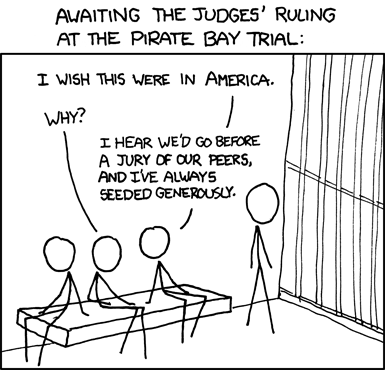
Why seeding is good for you

xkcd's take on the PirateBay trial.


So kids, fire up your torrent clients and start seeding.

Tuesday, February 24, 2009

Eircom to filter out pirate sites

Ireland has been suffering a bit of a copyright nightmare recently. Firstly, Eircom was sued by the music industry, and settled out of court conceding that it would implement some form of "three-strikes-and-you're-out" policy. As Sheldon from BBT would say "It is a sports analogy. Baseball to be precise".

Now it seems like Eircom will further bow down to the demands of an angry music industry by filtering out "pirate sites". This is such a far-reaching, disproportionate and blunt response that I am quite literally lost for words. It seems like the response from a panicked music industry is to revert Western ISPs to a type of totalitarian filtering state where only approved content can get through. Whatever happened to our dream of a free Internet?

What worries me the most is that strategies like these one tend to replicate across the globe. First it was New Zealand with its "guilt by accusation" legislation. Then it was Ireland thanks to a spineless Eircom. I am not a fan of slippery slope arguments, but it would not be an exaggeration to fear that something similar could happen in other countries. I am particularly concerned about potential official action following the Digital Britain report.

Here is an idea for a new business. Go somewhere sunny and set up a remote VPN company. What? Someone already wrote a book about such a thing? Drat!

Wednesday, February 18, 2009

Pirate Bay scores first hit on trial


The PirateBay's copyright infringement trial has gotten under way in Sweden. The press has been promising that it will be the "internet piracy trial of the decade" (I guess Grokster is chopped liver), but as Mathias Klang astutely points out, the likely result will be an appeal to the Swedish Supreme Court regardless of the ruling. What seems certain is that this trial will be a media circus, when the Pirate Bay bus is parked outside the courthouse you can reasonably expect that jocularity will ensue.

The trial is expected to hinge on a specific legal question, what exactly is the role of Torrent tracker sites within copyright law? The four defendants are accused by the music and film industries of facilitating the distribution of copyright materials, while PirateBay still claims that it does not host a single infringing copy in its servers, and therefore it acts more like a search engine than anything else. When users visit the Pirate Bay and search for infringing content, what they find are torrent files. These files contain small snippets of information about who else may be sharing the file by telling the client where to find the tracker. The files will connect the Torrent client to a tracker site, which is like virtual meeting rooms where users around the world can connect, and then exchange parts of the file between each other. The Pirate Bay hosts the torrent files, but trackers are everywhere. So the 2-year-in-jail question is, what is Pirate Bay's liability?

PirateBay has scored first with only two days of trial gone. The prosecution has dropped half of their claims, embarrassingly the most damaging ones. So the case has shifted from the accusation of "assisting copyright infringement" to "assisting making available copyrighted content". This is a huge step-down, as it may imply that the liability will not be criminal but civil in nature. I still think that PirateBay will lose, but it certainly looks bad for the copyright industries.

Two things have struck me about the trial. Firstly, there is certainly a very American tone to the proceedings despite the trial taking place in Sweden. The MPAA and the RIAA have been heavily involved in the prosecution, and on the other side, Harvard Law students are aiding in the defence's efforts. To me it feels almost like a proxy war being waged.

Secondly, the analogies with pirate lore and myth are undoubtedly going to help PirateBay. The trial is being played in the blogosphere in "Pirates of the Caribbean" terms. PirateBay are easily identified with Captain Jack Sparrow, Keira and Orlando; while the copyright industry are clearly cast as the evil East India Trading Company. While this romantisation of the legal plot may be puerile, it is undoubtedly going to play to the public imagination. Everybody loves an underdog.

Tuesday, February 03, 2009

Digital Britain or Digital Blunder?

The Digital Britain parliamentary commission has presented its interim report, which has been met with the usual journalistic brouhaha and bombastic statements. The more progressive media has kept a distrusting tone, while the usual suspects at the Telegraph and the Mail have hailed it as going in the right direction because it attacks piracy. I imagine that Telegraph editors and journalists might go apoplectic at the thought of young people downloading MP3s.

What does the report say? Digital Britain sets the government's Internet regulatory strategy for the next decade. The report tackles four main topics: network infrastructure, content, universal access, and e-government. The latter two are not very controversial. The digital divide and e-government are not the type of topics that move the wired masses into action any more. In these topics, the interim report is quite uncontroversial. The government will continue to make inroads towards universal connectivity, continue its electronic literacy campaigns, as well as making sure that more government services are offered online.

As expected, the two topics generating more controversy are networks and content. Digital Britain intends to move the UK towards a faster broadband by upgrading its backbone. This is not particularly controversial in itself, but what I find laughable, and many people in mailing lists do as well, is just how timid the report is in its objectives and methods. While many countries in the Far East and cities in the US have made some large public-private joint ventures to push for faster broadband, the report proposes the type of non-solution that inefficient government is infamous for. For example, one of the recommendations is to "remove regulatory barriers" so that private enterprises can do all on their own. Another one tells us that:

"We will establish a Government-led strategy group to assess the necessary demand side, supply-side and regulatory measures to underpin existing market-led investment plans, and to remove barriers to the timely rollout, beyond those declared plans, to maximise market-led coverage of Next Generation broadband."
Ugh. They might as well sit around in a room and have tea.

The content part of the report is not really much better. The section that has received most coverage is that of the way in which the government is going to tackle piracy. The interim report is seriously concerned about the widespread copying of copyright works, yet it seems to ignore that all of the legal solutions proposed in the last decade have not worked. They comment that in order to solve piracy, they intend to take the following action:
"By the time the final Digital Britain report is published the Government will have explored with interested parties the potential for a Rights Agency to bring industry together to agree how to provide incentives for legal use of copyright material; work together to prevent unlawful use by consumers which infringes civil copyright law; and enable technical copyright-support solutions that work for both consumers and content creators."
Let's party like it's 1999! The solution to illegal downloading is yet one more government agency, and wait for it, more technical solutions! Would these be the same technical solutions that are being ditched by pretty much everyone? Not only that, the interim report is backing a specific technology called ACAP (Automated Content Access Protocol). Needless to say, ACAP has been criticised from the start for not taking the user into account.

To put the nail in the coffin of the report's credibility, the government seems to be pushing for a 3-strikes solution. The interim report states:
"Our response to the consultation on peer-to-peer file sharing sets out our intention to legislate, requiring ISPs to notify alleged infringers of rights (subject to reasonable levels of proof from rights- holders) that their conduct is unlawful. We also intend to require ISPs to collect anonymised information on serious repeat infringers (derived from their notification activities), to be made available to rights-holders together with personal details on receipt of a court order."
The government seems to have realised its threat that it would enact legislation about notification to users if ISPs and content owners did not reach an agreement. It is worrying that a legislative solution to mandate the enactment of an ISP police is even being considered. However, it is noteworthy that the report has dropped the requirement of ISPs to cut out service, in favour of the more measured requirement to notify the user.

Unfortunately, the government seems to have drafted a technology report only listening to content owners and technophobes. Absent in the report is the plethora of bottom-up solutions that are moving the Internet forward, in favour of a centralised-yet-timid approach. The strategy is timid where it should be bold, and wherever it proposes firm action, it is only to benefit the copyright industry.

Too bad it is too early in the morning, I need a strong drink after reading this.

Wednesday, January 07, 2009

iTunes finally is DRM free

The economy is tanking, the sky is falling, locusts eat our crops, and zombies roam the streets looking for brains. So why do some of us keep obsessing with Apple's products and services? It's the end of the world and I feel fine I guess...

Anyway, Apple is set to announce that it will finally remove DRM restrictions on music downloads, undoubtedly following Amazon's DRM-free MP3 download service, and its own successful experiment with iTunes Plus. Apparently, it is already possible to upgrade one's music collection right now (I'm on the road so I cannot verify this), which opens endless money-spending possibilities for the iTunes enthusiast, and it is undoubtedly one of the reasons why this may have been so appealing for the music industry and Apple.

My New Year's resolution is not to state the bleeding obvious all the time, but I am going to break it by announcing that this decision was a no-brainer. It has become blatantly apparent to anyone with an eye on the entertainment industry that DRM does not act as a proper deterent, and that it garners particularly bad reactions from the public (remember Spore?). DRM is bad business, bad consumer management, and bad technology. It does not stop determined hackers and pirates from breaking it, and it only acts as a nuisance to users who have to struggle with ludicrous restrictions on whatever one has paid for.

Despite all the doom and gloom in economic terms, the copyright industry is still doing reasonably well. Game, DVD and music sales were up for 2008; download sales went up 33% last year as well, making it another record-breaking year. This despite other sectors of the music industry selling the message that all is bad and more regulation is required in order to curb piracy.

I'm now off to see how to spend more money online.

Friday, December 05, 2008

Pirates of the Amazon

Habitual and casual readers may have noticed my love of all things piratical. I've been a fan of pirates way before Johnny Depp donned the colourful bandanna and tricorn hat, mostly thanks to the great novel On Stranger Tides by Tim Powers. Granted, pirates have been getting a bad name recently due to their failure to look anything like Johnny Depp, and their relinquishing of romantic swords and muskets in favour of more deadly and proportionally less romantic AK-47s. Similarly, there is not one single parrot to be found in modern pirate speedboats and zodiac inflatable boats.

One of the welcome developments of the renaissance of maritime pirate activities off the coast of Somalia has been that finally there seems to be a much welcome backlash against the use (and abuse) of the word "pirate" to describe copyright infringement. Nasty-looking men with semi-automatic weapons who hijack oil tankers are in an entirely different league of wrong-doing to teenagers downloading music on torrent sites. In other words, criminal pirate activity tends to put copyright offences into perspective. As David Vaver said once, piracy is nowhere near equivalent to copyright infringement, just try to release a movie called "Infringers of the Caribbean", and not even Keira Knightley will draw the crowds into the cinema.

Why the pirate musings? Well, it seems like not everyone is happy with the state of affairs, and some people seem intent on maintaining the good (or bad, depending of where you stand) name of online piracy. Net Pirates are back with a vengeance as some bright sparks have created a Firefox plugin that adds a large "Download 4 Free" image to the Amazon website. This image is a link to the page in the Pirate Bay where the user can look at the torrent file with which to download the content for free, as advertised.


There are all sorts of opinions about this hack. The overwhelming response seems to be negative, going by the comments in a torrent-friendly site like Torrent Freak. Granted, this is a clever hack, and the authors claim that their application is "artistic parody", although I am lost as to the artistic value of such an act (call me a purist, but I do not think that pickled sharks and urinals are either artistic and/or clever).

Amazon sent a notice of take down to the makers of the plug-in, and they have complied by removing it, although I am reliably told that it can still be found in several torrent search sites. In my opinion, the legality of the issue is rather less straightforward. For example, the add-on does not deface the origianl website in any form, the changes to the way the site looks are done directly inside the user's computer by modifying the downloaded HTML code, an action akin to that performed by other Firefox plug-ins like Greasemonkey. As such, the user is simply modifying locally the way the page looks by adding a link to Pirate Bay. Similarly, I am not sure if this could somehow fall foul of trade mark law, as the actual modification is done upfront by the user downloading an add-on to the browser. It would be difficult to argue that the user who has installed the plug-in would be confused and would believe that Amazon offers links to Pirate Bay. In my opinion, this is a legal grey area, and it would be interesting to get a ruling on the subject.

A more interesting legal question is that of whether users have the right to make local modifications of HTML code. I cannot think of any exclusive right protected by copyright that would be infringed by this action. Given that temporary and cached copies of pages fall under exclusions in various copyright jurisdictions, I believe that such plug-ins are legal.

We are then left with a moral question, and there I agree with most critics. While I admire the chutzpah and impish nature of the plug-in, I agree with many people who have said that this may be counter-productive, and may give ammunition to copyright maximalists.

Please let the image of the Internet pirate go to its well-deserved place in the Recycle Bin of history.

Saturday, November 29, 2008

The internet is for gay porn...

... or so it seems for British lawyer firm Davenport Lyons, which has been sending letters on behalf of German gay porn makers to obtain payment from people who download their films through P2P and Torrent sites. But not only are individuals being accused of copyright infringement, stock photography sites are also pursuing small and medium enterprises for disproportionate amounts.

Some firms are fighting the charges, as they are often going to the wrong people. However, one has to wonder at the brilliant tactic used by obscure porn producers, who obtain much better dividends by making their film available on torrent sites, and then sue those who download it (or seem to download it).

Here is to hoping that someone will stand up to the bullies and they will get a black-eye in court.

Wednesday, October 15, 2008

The global copyfight rages on


The Wall Street Journal has published an excerpt provocatively named In Defense of Piracy from Lessig's new book Remix (out tomorrow). It seems like Lessig is still very much involved in the copyfight, highlighting the almost farcical story of Holden Lenz and Prince.

One could be forgiven for thinking that the copyfight has been relegated to a chapter in intellectual property textbooks. The music industry seems to have stopped suing its customers, and there has been a bit of an impasse with the attack on intermediaries and the three-strikes proposals. However, the copyfight is alive and well in countries that are updating their intellectual property legislation. Chile for example has been in the middle of drafting a new IP law, and it seems like there is a good old struggle going on down under. The government brought together a number of stakeholders to attempt to achieve a good balance between user and artist interests. However, the goverment completely undermined it by signing an agreement with the local collective society (SCD), and have sent forward a draft Ley de Propiedad Intelectual that makes the DMCA look like The Pet Goat.

Claudio Ruiz has written a post on the most worrying aspects of the draft law, which pretty much eliminates fair use, enhances liability for intermediaries, eliminates most educational exceptions, creates a virtual monopoly by the SCD, and most worryingly includes language that prohibits the renunciation of rights, making Creative Commons licences ineffective. After all, if you cannot renounce your rights, you cannot draft a "some rights reserved" licence! Christian Leal was interviewed on TV about the new law, and I found his explanations very well made. The Chilean blogosphere is up in arms about the turns of events (and the Facebook group against the law has now more than four thousand members!)

So the copyfight is alive and well. In the new digital economy, and with financial systems collapsing all around us, intellectual property is gaining more traction as a viable support for national economies, certainly more sustainable than ficticious credit instruments. We can therefore expect renewed interest in trying to squeeze the last penny out of intellectual creations.

Friday, August 29, 2008

How to stop piracy?

I think that everyone can agree that one of the problems with piracy is that it may have negative effect on some musicians. There is evidence that the music industry has become more reluctant to sign new acts and is relying on old names to stay afloat; and some small and medium artists have seen their works pirated indiscriminately. While we have become immune to pleas against music downloading from big names in the industry, it seems like the new marketplace is in turmoil. for example, CD sales continue to drop in the States, while they seem to go up in the UK. Similarly, P2P seems to affect established names, while it may benefit smaller acts. Meanwhile, Radiohead continues to innovate with their forward-thinking delivery methods.

What to do? It seems evident that the big stick strategy is not working. P2P enforcement is uneven, it has not stopped infringers, and most importantly, it seems to be targeting innocent users. Similarly, DRM is not the solution (mini-rant: whoever thought that DVD regions were a good idea? I had to spend hours hacking my MacBook's DVD protection to watch a legitimately purchased copy of War Games!).

One thing is clear to me. While in Costa Rica, I have been struck by the vibrant local music industry. Some artists are doing reasonably well for the market, including the amazing Malpaís. While this group is very popular with the download generation, their records are selling remarkably well. Apparently, buying th record has become an important part of being a Malpaís fan. The solution then has not been one of enforcement, it has been one of social awareness. I put forwrd then that the solution to piracy is to empower the consumer, just like Radiohead is doing. There are other schemes to invest in new bands, proving that the solution is in empowering the fan base.

I'm a bit tired, so I will not be issuing a pithy one-liner today.

Friday, July 04, 2008

Music industry chasing its own tail

The British media has been covering heavily the the news that the British Phonographic Industry (BPI) and Virgin Media have sent its first batch of threatening-yet-polite letters to some of its customers. The move seems to have backfired a bit, as inevitably a disgruntled student has come out claiming that the letter was sent to the wrong person. Will McGree (20), is accused of downloading Amy Winehouse, which from his worried tone seems to be a much more insulting claim than being directly accused of "stealing" music. This latest campaign is part of the new strategy by the music industry to curb infringement (previous coverage of Virgin's letter campaign here).

I have to say that I do not get the music industry. One minute they are complaining how digital technologies and digital downloads are destroying their livelihood, and the next they start claiming that things are going well, and the challenges are being met. This should come as no surprise, after all, the BPI has to send a message to the public that their precious artists are an endangered species, while they must also send a message to investors and shareholders to reassure them of future profits. The fact is that the very same BPI has now released a new set of figures which demonstrates that alternative business models and digital downloads are proving to be an excellent source of income, while providing evidence that CD sales have not slumped as they often complain.

So, here is my set of recommendations to the BPI. I do not know why, I'm just feeling a bit generous today (and they are not likely to read this, are they?):

  • Get your message straight. Is the digital environment good or bad? Are you suffering or profiting?
  • Ditch DRM. Even those who seem willing to buy into the whole "stealing music" propaganda do not like DRM. In fact, I think that it is the most important stumbling block for further growth of digital music.
  • Sending letters to customers is a bad business idea. They will switch to another competitor who does not send letters.
  • Give Broken Records a contract.
There, that advice will see safely you into the next decade; no need to thank me though, this one's on the house.

(Further discussion at the IPKat, but I disagree entirely with their take on it).

Update: Becky Hogge speaks out on the subject in Friction.tv.

Saturday, June 07, 2008

Virgin ISP to issue letters to file-sharers

If you can't beat them, send them a polite letter. This seems to be the latest strategy from the BPI. As the three-strikes policy seems to have failed, several outlets are reporting that the BPI has reached and agreement with Virgin Broadband to issue letters to its customers if there is a suspicion that someone may be illegally file-sharing in that household. The letter itself is quite interesting. It does not directly accuse the account-holder, but it states that:

"We have information that someone – and it may not be you – is using your Virgin Media internet account to access music illegally. However it happened, it is illegal. We therefore need you to take steps to stop it from happening again. The steps you can take are set out in the enclosed ‘What To Do Next’ section. You should know that if you don’t do this and the problem happens again, then you could face legal action."
This could definitely act as a deterrent, but it may also alienate customers and get them to switch providers. The other problem with this approach is that monitoring is not perfect, and it may produce false positives. The EFF has publicised an interesting study where innocent devices have prompted DMCA cease-and-desist letters just by being connected to BitTorrent.

This has been stated many times before, but it is worth repeating. If the music industry spent as many resources trying to change its business model to respond to the new realities in the digital environment, then they may have found ways of benefiting consumers, musicians and secure profits, while not alienating their customers.

Wednesday, June 04, 2008

The failing three-strike strategy

I've been reading Danny O'Brien's excellent post on troubled French three-strikes-and-you're-out law. Nick Jondet at French Law also informs us that the controversial piece of legislation will be presented later this month. This has left me wondering whatever happened to three-strikes here in the UK?


Those inclined to follow this story might remember that the year began with warning from the UK music industry that it would pursue a policy of allocating responsibility for online copyright infringement upon Internet Service Providers. The British blogosphere was up in arms (or more literally, up in thumbs) about the thought of having ISPs police internet piracy. Similarly, the European Parliament thought that this was a bad idea, as did just about every person with more than two working neurons. The thing is this, by removing access to the internet for an entire family, you are exercising punishment that goes beyond the offence. Not only that, in the digital age access to the internet has become an important part of everyday life, and removing it via an administrative decision violates every principle of justice that I can think of.

The three-strike policy seemed like the natural next-step escalation on the War Against Piracy. Suing the clients failed. Suing the users failed. Bribing college kids failed. So let's sue the ISPs! Or get them to enforce copyright for us! Funnily enough, I believe that the music industry may have realised that the decision has become unpopular. The BPI threatened to sue Carphone Warehouse if they failed to make the necessary appeasing sounds, an ultimatum that failed to materialise. Meanwhile, the music industry may be shelving their three-strike plan because of the prompt action by advocacy groups and the European Parliament. Some bad copyright policy may have been averted. Am I being too optimistic? Only time will tell.

On a related note, I was going to name this post "Whatever happened to... three-strikes?" but when I googled the title I realised that it had been used already by Andrew Orlowski. Ugh. I am deeply disturbed by that, I need to go and take a shower.

Friday, April 18, 2008

BitTorrent traffic still growing

Ars Technica has an interesting story on the continuing growth of BitTorrent traffic, yet the head of anti-piracy operations at the MPAA says that things are getting better.

The problem for those figthing BitTorrent traffic is that sites are one Google search away, regardless of which tracker site you prefer. Google "galactica torrents" and the first page is filled with tracker sites where you can download the show. This is why the current legal battle against sites such as The Pirate Bay are doomed to fail.

Friday, April 11, 2008

European Parliament votes against three-strikes

(via Philippe Aigrain) There has been a bit of an overload on the three-strikes proposals these last few weeks, but I think that this is really important. The European Parliament voted last Wednesday on report A6-0063/2008 on Cultural industries in Europe. The report originally looked the the average pro-copyright industry document, although it stated that "criminalising consumers not seeking to make a profit is not the right solution to combating digital piracy."

Interestingly,
the document's rapporteur Guy Bono has clearly been following the debate on the three-strikes proposal. Much like yours truly, he recognises that cutting-off internet service to an infringer is a disproportionate response in the digital age. He commented that:

"On this subject, I am firmly opposed to the position of some Member States, whose repressive measures are dictated by industries that have been unable to change their business model to face necessities imposed by the information society. The cut of Internet access is a disproportionate measure regarding the objectives. It is a sanction with powerful effects, which could have profound repercussions in a society where access to the Internet is an imperative right for social inclusion."
Excellent point. The parliament agreed, and adopted the inclusion of the following paragraph to the report:
"Calls on the Commission and the Member States to recognise that the Internet is a vast platform for cultural expression, access to knowledge, and democratic participation in European creativity, bringing generations together through the information society; calls on the Commission and the Member States, therefore, to avoid adopting measures conflicting with civil liberties and human rights and with the principles of proportionality, effectiveness and dissuasiveness, such as the interruption of Internet access."
I believe that this may prove to be the tipping point against the ludicrous three-strike policy. ISPs are clearly uneasy about becoming enforcers (and they should). Everyone with more than two functioning neurons has been able to recognise that the proposal is unworkable. Now the European Parliament has thrown its weight against the policy. One hopes that this may prove to be the death of this proposal.

Wednesday, April 09, 2008

The ISP rebellion

Much virtual ink has been spent discussing the latest attempt to shift liability for illegal file-sharing back to the intermediaries. UK ISPs are said to be in negotiation with the British Phonographic Industry in order to turn them into enforcers. ISPs are supposed to disconnect illegal file-sharers after other disciplinary action has been taken. No ISP had spoken against such action, but last week, the chief of Carphone Warehouse has come out and attacked the plans as the unworkable mess that they are. He said that "I cannot foresee any circumstances in which we would voluntarily disconnect a customer's account on the basis of a third party alleging a wrongdoing." a brave position in my opinion. I have already said that turning ISPs into an enforcer of IP rights cannot be done, and disconnecting an entire family's internet service for the sins of one member seems rather extreme. Just wait for the first news item recounting Little Ian's trouble with his homework because of the Big Bad Music Industry, and you will see just how this plan is doomed.

However, things could get messy for Carphone Warehouse. The BPI has called their response "irresponsible", and according to the Daily Telegraph, the BPI has threatened them with legal action if they do not comply. Apparently, they sent a fax which says:

"... unless we receive your agreement in writing that within 14 days Carphone Warehouse will implement procedures set out above, we reserve our right to apply to court for injunctions and other relief without further notice to protect our members' rights."
This is clearly where the music industry's strategy lies. It has been trying to get agreements of enforcement from ISPs, but the underlying threat has always been legal action. Comply or else.

I hope that the Carphone Warehouse sticks to its guns. For starters, we may get a clear ruling defining ISP liability once and for all. I would also believe that Carphone Warehouse has a good chance of winning the case, which would be more problematic for the music industry than it is for the ISPs. If they fail in this tactic, what will they try next?

Anyway, the BPI are barking up the wrong tree. New research clearly indicates that the problem of sharing music is not an online problem, it is people sharing music with their friends, just as it has always been. We haven't really moved much from the good old days of the mix tape it seems. And then we get Feargal Sharkey telling us that unless this is stopped, musicians will stop making music. Somehow, I do not think so.

Tuesday, April 01, 2008

Who broke the Internet?

The Internet is broken. You may have noticed some of the signs: slow connections, sluggish downloads, constant disconnections, lost emails, tons of spam. Who broke it, and how can we fix it?

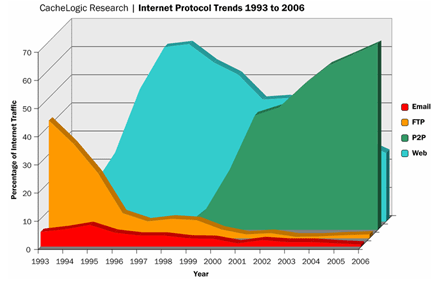
This was part of a very interesting talk by Chris Marsden at BILETA 2008, an earlier version of which can be found on SCRIPT-ed. At the heart of the topic of network neutrality lies the very real fact that there is a serious problem with current architecture. Bittorrent protocol is a wonderful way of transferring large files, but it is resource-heavy. Small number of users can hog as much as 70-80% of the network traffic at any given time.

How can this be stopped? Many ISPs have started working on traffic-shaping, throttling, and using other restrictive tools. The justification for these practices is that by throttling bittorrent protocols, it is possible to make sure that the rest of users will not see their service affected. In an unfair situation, placing caps on protocols guilty of hogging the network would be a good idea. To me the "gotcha" moment came when I saw a chart by George Ou, presented at the Network Neutrality hearings in Washington. To me, this is incontrovertible proof that Something Must Be Done:

The problem is of course that current solutions to the problem, such as rate limiting, are inherently unfair, as they castigate the legitimate and occasional bittorrent user as well as the hardcore seeder. It also can be partially circumvented through encryption, although I have heard it on good authority that encryption can be easily shaped.

Bob Briscoe, a researcher at BT, is proposing a change to the network architecture that has been in place since 1986. Current TCP/IP traffic is handled through the additive increase/multiplicative-decrease (AIMD) algorithm, which shapes current congestion through the network. Briscoe and others argue that the current algorithm is unfair as it allows a bittorrent user to open many streams for sharing the same content, while someone browsing will only use one session, which favours the bandwidth hog in detriment of the normal user. The proposed change is to allow for a weighted TCP algorithm, which will allocate similar bandwidth to users, regardless of the number of streams they have open at the same time.

I find Broscoe's proposal elegant and logical, but most importantly, I like the idea of fixing an architectural problem through architecture. Amongst all of the regulatory debates about the subject, I find that the best solution is not to legislate, but to fix the broken protocol.

Now, if I can only get my BT Vision box to work, I will be a happy man.

Monday, March 17, 2008

ISP police, Sweden says no

While many news sources reported last Friday that Sweden was going to get tough on illegal file-sharing, most failed to mention one of the most important parts of the statement. While it is true that Sweden is considering asking ISPs to identify file-sharers, ministers have ruled-out asking ISPs to police the network and remove access to the Internet for offenders. A comment in the Swedish press on the subject of ISPs reads:

"The proposal in the Renfors-review that ISPs should be given the right and be forced to shut down subscribers whose Internet subscription has repeatedly been used for infringing copyrights has met with strong criticism. Many have noted that shutting down an Internet subscription is a wide-reaching measure that could have serious repercussions in a society where access to the Internet is an imperative welfare-issue. The government has, because of this, decided not to pursue this proposal." (Translation Vera Franz)
This is such an accurate statement, yet it seems to have bypassed a lot of policy-makers pushing for the "three strikes" approach. In an era where Internet has become a sign of social and economic inclusion, cutting access to the Internet for an entire family could prove more damaging than the perceived threat. Moreover, this steep punishment is being suggested as an administrative sanction performed by a private body. Whatever happened to due process of law and all that?

Update: Mathias Klang beat me to the story. He's Swedish after all :)