Monday, March 05, 2007

Virtual spam

I've received one piece of blog comment spam, and as a matter of policy I deleted it. However, I have removed the links and I have felt compelled to keep it for posterity:

"Welcome to our website for you World of Warcraft Gold,Wow Gold,Cheap World of Warcraft Gold,cheap wow gold,buy cheap wow gold,real wow gold,sell wow gold, ...wow powerleveling Here wow gold of 1000 gold at $68.99-$80.99 ,World Of Warcraft Gold,buy wow gold,sell world of warcraft gold(wow gold),buy euro gold wow Cheap wow gold,cheapest wow gold store ... buy euro gold wow wow gold--buy cheap wow gold,sell wow gold.wow powerleveling welcome to buy cheap wow gold--cheap, easy, powerleveling wow gold purchasing.World of Warcraft,wow gold Super ...
We can have your wow gold,buy wow gold,wow gold game,world of warcraft gold, wow Gold Cheap wow, Cheap wow gold,world of warcraft gold deal,Cheap WOW Gold ...
Welcome to our website for you World of Warcraft Gold,Wow Gold,Cheap World of Warcraft Gold,wow gold,buy cheap wow gold,real wow gold,sell wow gold, ...
Here wow gold of 1000 gold at $68.99-$80.99,powerleveling World Of Warcraft Gold,buy wow gold,sell world of warcraft gold(wow gold),buy gold wow lightninghoof instock Cheap wow gold,cheapest wow gold store ...
wow gold--buy cheap wow gold,sell wow gold.welcome to buy cheap wow gold--cheap, easy, wow gold purchasing.World of Warcraft,wow gold Super ...
Wow gold- Gold for buy gold wow lightninghoof instock EU-Server: ...wow Gold EU: starting from 84,99?; 3000 WoW Gold EU: starting from 119,99?. wow Gold- Leveling Services: ...
We can have your wow Gold,buy wow Gold,wow Gold game,wow gold, Cheap wow Gold, Cheap World of Warcraft Gold,world of warcraft gold deal,buy cheap wow gold,Cheap WOW Gold ...
Here wow Gold of 1000 gold at $68.99-$80.99,World Of Warcraft Gold,buy wow Gold,sell world of warcraft gold(wow gold),Cheap wow gold,cheapest World of Warcraft Gold store ... "
OK. We get it. You are selling gold for World of Warcraft. WOW. Gold.

Saturday, March 03, 2007

Conservapedia

So, you are a member of the religious right in the United States. You go online to find information to defeat those heathen atheists and their plot to subvert the youth by teaching the evils of Evolutionary theory. But what do you find? Wikipedia is biased against Creationism and the right!

What do you do? You found Conservapedia, a place where home-schoolers can get their biblical facts straight without Euro-pinko-lefty-contamination. Conservapedia, where the entry on dinosaurs reads:

"Because the term only came into use in the 19th century, the Bible obviously does not use the word "dinosaur." However, they are alleged to be mentioned in numerous places throughout the biblical account. For example, the behemoth in Job and the leviathan in Isaiah are sometimes said to be references to dinosaurs."
The entire entry on France reads: "A country in Europe. Thrived during the middle ages. The capitol is Paris, France, which was founded in the Middle Ages."

Inspired stuff. Jimmy Wales must be trembling as we speak.

Thursday, March 01, 2007

The Joyce Hatto scandal: iTunes and plagiarism


The world of classical music has been shaken by the Joyce Hatto scandal. For those unaware of the affair, Joyce Hatto was a pianist whose career was cut short in the 1970's due to cancer. However, in 1989 she started recording again and producing CDs with her husband's independent record label. When she died in 2006, The Guardian pronounced her "one of the greatest pianists Britain has ever produced".

Unfortunately, she was not the great one, her husband's recording capabilities were. It seems like all her output since 1989 had been copied from other artists. How was the trick discovered? Through iTunes of course! Tipped by readers, music magazine Gramophone tested several of Hatto's CDs on the database, only to discover that iTunes recognised them as being recorded from other artists. iTunes believed that the first CD was from Laszlo Simon, while the second had been the work of Yefim Bronfman. After the deception had been uncovered, William Barrington-Coupe, the guilty widower, admitted to it.

How did iTunes recognise the original? iTunes uses Gracenote's CDDB, a database which enables third party applications to identify individual CDs so that it can automatically discover cover art, artist, title and label. CDDB is powerful enough that it will identify songs without metadata if they are in the same correct order and have the same length as the original. This is because CDDB creates a unique fingerprint of each CD on the database called a 'discid'. This contains information about the CD's song order, length and other data. It seems like Mr Barrington-Coupe's error was to copy the CDs as they were instead of mixing them a bit.

As any amateur CD-ripper knows, CDDB will not identify your own compilations.

Wednesday, February 28, 2007

Number 10 answers software patent petition


(via Laurence Diver and other sources) The Prime Minister's office has been accepting online petitions, which has prompted all sorts of people making specialist requests. One such petition has been posted against software patents, which reads "We the undersigned petition the Prime Minister to make software patents clearly unenforcible". The petition gathered 2,215 signatures.

Perhaps more astounding than the actual petition was the very informed reply. The response reads:

"The Government remains committed to its policy that no patents should exist for inventions which make advances lying solely in the field of software. Although certain jurisdictions, such as the US, allow more liberal patenting of software-based inventions, these patents cannot be enforced in the UK.

The test used to discern between patentable and non-patentable subject matter in the UK has recently been clarified by the courts, and is applied rigorously by the Patent Office. Under this test, the true nature of the advance being claimed in a patent application must be determined, and if this advance lies solely in the field of software, or another non-technical field such as methods of doing business, the patent will not be granted. If the advance being made by an invention does lie in a technical field, it must also be non-obvious and sufficiently clearly described for the invention to be reproduced before a patent will be granted by the Patent Office.

The recently published Gowers Review of Intellectual Property, an independent review commissioned by the Government, recommended that patent rights should not be extended to cover pure software, business methods and genes. The Government will implement those recommendations for which it is responsible, and will therefore continue to exclude patents from areas where they may hinder innovation: including patents which are too broad, speculative, or obvious, or where the advance they make lies in an excluded area such as software."
However, notice that the language is still against "pure software", or "software as such". As I have commented often, some software patents will still get through, but this is an encouraging sign.

Tuesday, February 27, 2007

Resuming normal service

Those few regular readers who care about these sort of things may have noticed that I have not been posting that often in the last few days. I have been moving flats, which has of course affected my online connection as well. I have finally moved everything and I'm now online. Expect posting to become regular again.

How did we ever manage without broadband?

Monday, February 26, 2007

eBay bans in-game goods

(Valuable item from Ultima Online)

(via Colin Miller) This is an old item, but I've just read it. According to Slashdot, eBay has caved-in to increasing pressure from the games industry and has de-listed all in-game items from its database. However, I've made a search and you still can find some items. If you want to buy gold, rare items, swords of power and exotic pets, you will have to go to other websites. In many instances, you may have to go to officially sanctioned websites, such as Sony's Station Exchange, in order to get your goodies. Why? Because this could be another profitable source of income for MMORPG providers.

For those who are not familiar with virtual economies or gaming, there are online games in which players can obtain highly prized rare and/or collectible items through skill and labour within the virtual world (the relevance of the use of such words will become clear). It is also possible to accumulate in-game wealth in the shape of gold or other currency, which can be transferred to other players. Such items have generated an economic boom in which people would spend real money to purchase their online game-only items, fuelling virtual farming, where people from developing countries would be used in virtual sweatshops to produce said currency. Game companies saw the booming market, and started offering their own shops.

How could game developers maintain their official stores as the monopolistic provider of virtual goods? After all, one could undercut the official market by creating an underground economy where virtual goods could be freely exchanged, a traditional black market if you may. The solution to the conundrum was actually quite simple, yet inspired. Claim intellectual property protection over all goods generated in the game through constrictive EULAs, and punish all of those who break the agreement or infringe the company's IP. By doing this, then eBay could eventually be held liable for serving as a marketplace for infringing materials, hence last month's action.

Do game companies have a case? I personally do not think so, as some of the clauses could be found abusive in Europe. I also think that virtual items created through the gamer's skill and labour should be rewarded with their own copyright protection. After all, Microsoft does not own the copyright over anything I write with Word, so why should the game maker get the copyright over what I create within the game? To emphasise this point, Second Life allows gamers to claim copyright over their creations, allowing the use of Creative Commons licensing for some works.

This has been the subject of some literature already of course, but I just wanted to have a wee rant.

Saturday, February 24, 2007

Creative Commons version 3.0 launched


The version 3.0 f the generic (or unported) Creative Commons licences have now been released. There are many important improvements in the new licences. The biggest change has been to distinguish between the generic licence and the American one. The generic is now drafted with neutral international language in accordance to the Berne Convention, so finally we are rid of the confusing terms like "derivative" (although the licence is still called No derivs), but the language now refers to adaptations.

Other changes are the consistent changes to moral rights treatments, and specific language to make it easier for music groups to collect royalties from collecting societies. Here is a list of changes according to the original post from Mia Garlick:

"Separating the “generic” from the US license

As part of Version 3.0, we have spun off the “generic” license to be the CC US license and created a new generic license, now known as the “unported” license. For more information about this change, see this more detailed explanation.

Harmonizing the treatment of moral rights & collecting society royalties

In Version 3.0, we are ensuring that all CC jurisdiction licenses and the CC unported license have consistent, express treatment of the issues of moral rights and collecting society royalties (subject to national differences). For more information about these changes, see this explanation of the moral rights harmonization and this explanation of the collecting society harmonization.

No Endorsement Language

That a person may not misuse the attribution requirement of a CC license to improperly assert or imply an association or relationship with the licensor or author, has been implicit in our licenses from the start. We have now decided to make this explicit in both the Legal Code and the Commons Deed to ensure that — as our licenses continue to grow and attract a large number of more prominent artists and companies — there will be no confusion for either the licensor or licensee about this issue. For a more detailed explanation, see here.

BY-SA — Compatibility Structure Now Included

The CC BY-SA 3.0 licenses will now include the ability for derivatives to be relicensed under a “Creative Commons Compatible License,” which will be listed here. This structure realizes CC’s long-held objective of ensuring that there are no legal barriers to people being able to remix creativity in the way that flexible licenses are intended to enable. More information about this is provided here.

Clarifications Negotiated With Debian & MIT

Finally, Version 3.0 of the licenses include minor clarifications to the language of the licenses to take account of the concerns of Debian (more details here) and MIT (more details here).

As part of discussions with Debian, it was proposed to allow the release of CC-licensed works under DRM by licensees on certain conditions — what was known as the “parallel distribution language” but this has not been included as part of Version 3.0 of the CC licenses."

This is a huge step for CC licensing. Expect the version 3.0 of the Scottish licences shortly.

Monday, February 19, 2007

Internet addict sues IBM

You could not make up stories like these even if you tried. James Pacenza used to work for IBM until he got fired for participating in adult chat rooms. He now has sued IBM because he claims to be a sex addict and an Internet addict, and that under his condition he's entitled to protection under the American with Disabilities Act.

While this has some comedic value, the case could be the first test of Internet addiction. As early as 1998, clinical psychologists have been claiming that the Internet can be addictive. A PubMed search on "internet addiction" retrieves 156 results. Could this person have a case if there is such a thing as Internet addiction?

Having played MMORPGs from time to time, I can empathise with the addictive claim.

Thursday, February 15, 2007

Music downloads do not affect sales

(Via Howard Knopf) Those involved in the P2P debate might remember the 2004 Oberholzer-Gee and Strumpf paper on the effect of music downloads on sales. The paper has now been published in the Journal of Political Economy with updates. The abstract reads:

"For industries ranging from software to pharmaceuticals and entertainment, there is an intense debate about the appropriate level of protection for intellectual property. The Internet provides a natural crucible to assess the implications of reduced protection because it drastically lowers the cost of copying information. In this paper, we analyze whether file sharing has reduced the legal sales of music. While this question is receiving considerable attention in academia, industry, and Congress, we are the first to study the phenomenon employing data on actual downloads of music files. We match an extensive sample of downloads to U.S. sales data for a large number of albums. To establish causality, we instrument for downloads using data on international school holidays. Downloads have an effect on sales that is statistically indistinguishable from zero. Our estimates are inconsistent with claims that file sharing is the primary reason for the decline in music sales during our study period."
I have not yet read the published version, so I do not know if there are any changes to the unpublished one. The original prompted some angry replies, and even some reasoned rebuttals.
The study comes at a time when EMI has worried the music industry by stating that its profits have plummeted because of decreasing sales.

IF P2P does affect sales (this is a big IF), then doesn't that mean that the music industry has lost the war on piracy? Suing all of those users has not had an effect, so it may be a good time to re-think business models. I think that getting rid of DRM may actually do the trick. I know that I would buy more from iTunes if their music was DRM-free.

Wednesday, February 14, 2007

UK Law Database

Finally! Looking for UK legislation? The Department of Constitutional Affairs has released its Statute Law Database. No longer will you have to guess the legislation's name to find it in Google, everything is now available in one place.

I've been browsing it (as you do), and I think that it looks very comprehensive, particularly the regional support. The database includes Scottish Parliament acts and Scottish statutory instruments, so I'm glad to see that Scotland is given its proper place.

The database still has some holes: the Consumer Credit Act 1974 is still not online.

Tuesday, February 13, 2007

Web 2.0 video

Creative Commons blog and even Eben Moglen are all talking about this video explaining Web 2.0, the hyper-web, or however you want to call it. It was quite an amazing display, really well done. Web 2.0 is one of those terms that I see defined in different ways. Originally, it was meant a description of web-based or browser-based applications, such as gMail, Google Desktop, gadgets, Windows Live, etc. Now it is used to describe user-generated content, social networking and the wiki web.

I still felt that the point was over-stated. Do we really need to re-think everything?

Saturday, February 10, 2007

Vista Wow? More like Boo!

So, as part of my research into software and operating systems, I purchased a cheap OEM version of Vista and installed it on my new and shiny Core 2 Duo system. I also installed OpenSUSE 10.2 as a dual boot to test comparative installation times and ease of use.

Vista looks good, Microsoft has really done a sterling job with Aero and the look-and-feel of the operating system. The menus are approachable and easy to use, and the desktop is definitely one of the nicest out there, with the exception of Mac's stylish workspace. However, I became easily exasperated by Vista's new security features, particularly the User Account Control (UAC). As a power user, I like to be in control of my operating system, something that is very difficult to exercise in Vista. While I know that this will make the new OS tremendously secure, I found the constant prompts when I wanted to do something a serious nag factor. Worse, I could not even delete files! Sure, I do not want a virus, spyware or zombie master taking over my system, but I would like from time to time to delete a file or two if I feel like it.

A more serious problem that I've encountered is that my favourite software does not work in Vista. An operating system is only as strong as the applications you can run. My anti-virus did not work (BitDefender), neither did iTunes, Winamp and my motherboard's tuning software. Firefox encountered serious problems when I tried to install plugins, and whenever I tried to install anything, chances were that the features were not compatible with the operating system. I know that this is a problem that is shared by other 64 bit architectures, but I felt that the application support is woeful.

To round things nicely, nothing works in OpenSUSE. It seems like the Linux driver support for my chipset is not there, so I did not have Internet access right away. Seems like I'm stuck with XP for a while.

Update: This is my first post from Vista though.

Friday, February 09, 2007

Has DRM had its day?

Apple boss Steve Jobs has surprised pretty much everyone by making a statement about technological protection measures in the music industry, in a move reminiscent of Bill Gates' comment about how DRM had become too complex for consumers. In an open letter to the public, Jobs has stated that:

"Why would the big four music companies agree to let Apple and others distribute their music without using DRM systems to protect it? The simplest answer is because DRMs haven’t worked, and may never work, to halt music piracy. Though the big four music companies require that all their music sold online be protected with DRMs, these same music companies continue to sell billions of CDs a year which contain completely unprotected music. That’s right! No DRM system was ever developed for the CD, so all the music distributed on CDs can be easily uploaded to the Internet, then (illegally) downloaded and played on any computer or player.

In 2006, under 2 billion DRM-protected songs were sold worldwide by online stores, while over 20 billion songs were sold completely DRM-free and unprotected on CDs by the music companies themselves. The music companies sell the vast majority of their music DRM-free, and show no signs of changing this behavior, since the overwhelming majority of their revenues depend on selling CDs which must play in CD players that support no DRM system.

So if the music companies are selling over 90 percent of their music DRM-free, what benefits do they get from selling the remaining small percentage of their music encumbered with a DRM system? There appear to be none. If anything, the technical expertise and overhead required to create, operate and update a DRM system has limited the number of participants selling DRM protected music. If such requirements were removed, the music industry might experience an influx of new companies willing to invest in innovative new stores and players. This can only be seen as a positive by the music companies."
This is remarkably sensible, and at least it has opened the debate against DRMs. It is heartening that such a powerful voice as Jobs has seen the light. To be fair, he is probably just worried about slumping sales in iTunes, and he wants to make sure that Apple will end-up with the largest piece of the digital downloads cake. With so many companies placing themselves as competitors, and with Microsoft Vista and Zune placing themselves as a viable competitor, Jobs and Apple want a cut of the sales. iTunes has brand recognition, and if their music can play anywhere, then they would probably see their sales increase.

The music industry has not responded well to the suggestion of course. Warner Music's boss Edgar Bronfman has already pronounced that Jobs' ideas are "without logic and merit". Strong words from one of the biggest names in the music industry.

I'm going to sound extremely optimistic here, but I think that at least we're having a debate about DRM, and the story has made the headlines.

Tuesday, February 06, 2007

Sex offenders must register e-mail address

And the 2007 prize for the most useless piece of online regulation goes to....

The Beeb reports on the latest proposal from Home Secretary John Reid to force paedophiles and other sex offenders to register their electronic mail details, as well as chat-room login names and other virtual identifiers in order to avoid Internet grooming. The Internet is after all full of nasty people.

And this will work how? Sure, sex offenders will register their details, and open a new Hotmail account the same minute they register the old one. And of course, nobody can register a new user name in a forum. That one has never been tried before either.

At least John Reid did not say that we must regulate the Internets...

Monday, February 05, 2007

Personality rights wiki

The AHRC Research Centre for Studies in Intellectual Property and Technology Law has now released a personality rights wiki, where you can browse the latest cases on personality rights from all over the world. Do you know a case that is not listed? Write a stub for it, a note, or just drop a quick link.

Friday, February 02, 2007

Blackboard issues OS patent waiver

A follow up on the Blackboard patent story. Blackboard has seen the writing on the wall and has issued an enforcement promise for open source software projects. According to the terms of this pledge, Blackboard will not enforce U.S. Patent 6,988,138 against software released with an open source licence. According to the press release:

"[...] the Pledge commits Blackboard not to assert U.S. Patent No. 6,988,138 and many other pending patent applications against the development, use or distribution of open source software or home-grown course management systems anywhere in the world, to the extent that such systems are not bundled with proprietary software."
Too little too late? I'm not sure about the enforceability of unilateral promises in the United States, but I hope that this pledge is valid.

Thursday, February 01, 2007

Identity Society event in London

Luke Razzell has forwarded this invitation to an event in London for publicity purposes.

Identity Society is delighted to announce an Open Space event (aka "unconference") on February 19th in the revolving restaurant space on the 34th floor of the BT tower in central London. The tower's curious history as an Official Secret is detailed here. Our panoramic views (one shown below) will surely inspire us to think big about our objectives. Identity Society is still just a twinkle in our eye—this event is an amazing opportunity for you to contribute to its meme pool at inception.

But what is the Identity Society actually about?

a view from BT towerOur integrated experience of our own and others' identity helps us make sense of our life: each person's unique, individual experience is threaded though their interactions with friends, family, businesses, government, doctors, the legal system and information of all kinds. At the same time, as individuals, we are very skilled at selectively disclosing and concealing aspects of our identity according to context and need.

So, given our consumate individual skills with identity, why is our society so often so poor at mediating the flow of identity information for helpful outcomes? Why can't we make key medical information readily available to doctors in an emergency without compromising our privacy at other times? Or enjoy a personalised shopping experience that is joined up across retailers? Or have our government vouch for our identity without allowing them to track our every action? What is the psychological impact of revealing or concealing our identity in various situations? And at root, what does identity mean anyhow?

These are just a few of the questions that Identity Society might address. But the Open Space event is an opportunity for us to work out what the best questions really are, and to begin to devise an effective strategy to answer them. Some of the best and the brightest in the UK and US identity scene are already signed up to attend—we hope to see you there too!
Click here to register!
I cannot attend, but it seems like an excellent event.

Wednesday, January 31, 2007

USPTO to examine Blackboard patent

Excellent news coming from the Software Patent Law Center (SFLC). The USPTO has granted ex parte re-examination of US Patent 6,988,138, which protects "Internet-based education support system and methods". As previously reported, this patent led to its owners, e-learning software firm Blackboard, to sue Desire2Learn, which also manufactures educational software.

The SPLC initiated the re-examination procedure on behalf of several open source software projects. According to their press release:

"A re-examination of this type usually takes one or two years to complete. Roughly 70% of re-examinations are successful in having a patent narrowed or completely revoked."
It will take some time to learn the outcome, but at least it has been challenged. Well done!

Tuesday, January 30, 2007

HD-DVD DRM cracked


(Via SCRIPT News) The copy-protection system shipped with every HD-DVD has been cracked, according to the firm in charge of licensing, Advanced Access Content System (AACS).

As with DVDs before, licensed players come with a built-in encryption key (device key) which can unlock the content within High Definition discs, protected with another set of keys (volume keys). In DVDs, the protection was broken when a digital player forgot to encrypt their keys. In this case, the culprit was a self-proclaimed upset customer that goes by the nick muslix64. In an interview with Slyck News, he tells how he was looking at the transaction between the device and volume keys, and how he realised that the volume keys were not protected in the player's memory. Mr muslix64 decrypted the keys and created a command-line open source program called BackupHDDDVD, which obtains the volume keys. Once this has been achieved, the disc is left wide open. Just to be fair, he also cracked Blu-Ray's protection.

AACS has accepted the crack, and has stated that it will employ "both technical and legal measures to deal with attacks such as this one". The technical actions may include desperate measures such as deactivating the affected players (which would create a lot of anger amongst consumers), or to update players by sending software updates to users. Yeah, right! The users are going to update the software all by themselves. You cannot fault these people's optimism.

Whatever happens, it is clear that muslix64 will be on the industries sights. After all, he's wilfully circumventing effective protection measures.

Sunday, January 28, 2007

TV industry to enforce BitTorrent?


I've just read a rather naive article in the BBC Technology website on the rise of BitTorrent TV-show sharing. According to the report this is the next stage in the fight against piracy, as the top shared material online now is made up of TV shows.

I'm sure that TV industries must be concerned. Shows are now offered with the commercials removed, ready for download though the many torrent sites available. Downloading also affects viewing figures and it makes it more difficult to measure a show's popularity.

I admit that I have become fond of downloading shows from BitTorrent, particularly Battlestar Galactica. Over my holidays I also downloaded Terry Pratchett's Hogfather and Torchwood. Is this infringing? Certainly, but then I have purchased Galactica DVD's after viewing, so not watching the show "live" is offset by the income gained through a DVD.

Honestly, I cannot see how the industry can try to stop BitTorrent sharing. Its nature is different to traditional client-based P2P sharing such as Limewire, there is no central network to attack, only individual users. You could also try attacking the torrent search engines, but as the content is not hosted by them, the legal case against them would be less straight-forward.

Saturday, January 27, 2007

Latest FACT video against copyright

(via Ashley Theunissen) I recommend that you watch this video from the UK's Federation Against Copyright Theft (FACT). Apparently it is being distributed in rental DVDs instead of the annoying Piracy Crime video, but I don't know if it is new. I initially thought it was a spoof, but apparently it's quite real. I loved the over-the-top pirate branding things with an X, while the voice-over tells us useful facts like "The pirates are out to get you"; "Piracy funds terrorism" and "Don't let the pirates burn a hole in your pocket".

And remember, "Cool is Copyright!" (who wrote that? Yoda?)

Friday, January 26, 2007

PR firm attacks open access


(via Open Access News) Journal publishers represented by the Association of American Publishers (AAP) have hired a PR firm in order to raise morale and attack open access publishing, according to a report in the journal Nature. "We're like any firm under siege, it's common to hire a PR firm when you're under siege." said the president of the AAP. According to the article:

"The consultant advised them to focus on simple messages, such as "Public access equals government censorship". He hinted that the publishers should attempt to equate traditional publishing models with peer review, and "paint a picture of what the world would look like without peer-reviewed articles"."
The twisted logic required to come up with the phrase "Public access equals government censorship" leaves me in uncomfortable awe. In some people's mind one can imagine that providing wider participation and access is wrong, but I truly cannot fathom the mental process which produces such line of thought. I am similarly amazed by the false dichotomy deployed by implying that open access equals the demise of peer-review.

This is what happens when you bring mindless PR firms into intellectual debates.

Thursday, January 25, 2007

Enforcing Creative Commons

Licence geeks may have noticed the following information in the right-hand column of this blog:

Creative Commons License
This work is licensed under a Creative Commons Attribution-Noncommercial-Share Alike 2.5 UK: Scotland License.

The terms of the licence are simple. I will allow people to reuse and republish my posts as long as they provide attribution to the original posts, are not reproduced for commercial purposes, and the person making the reproduction shares any modifications from the original content with a licence containing the same terms and conditions.

Thanks to the magic of the link-back function in Blogger, I have discovered that there is an outfit copying my messages through the Atom feed and placing them in pages filled with Google Ads. The pages have content from other blogs from all over the place, which makes me believe that this is almost certainly a Google Ad link farm. The domain is bgtoyou.com, with the www replaced by random numbers preceded by a g. Examples of this are yesterday's post, as well as:

http://g46.bgtoyou.com/The-Independent-Republic-of-Sealand
http://g71.bgtoyou.com/Is-Second-Life-Open-Source/
http://g122.bgtoyou.com/Should-Saddams-video-be-regulated/
http://g41.bgtoyou.com/Spanish-cafe-loses-case-on-free-music

Using the excellent Network Tools utility I found that the domain is owned by a person in Thailand. I emailed the registered owner to complain, but unsurprisingly I have not received an answer. I then used a traceroute to find who is hosting the content, and found that it is being served from hostgator.com in the United States. I then emailed the site's support to explain the situation, and I have been prompted to file a DMCA complain to remove the material.

Why enforce the licence terms? I write this blog without expecting to get money in return, and the thought of somebody profiting from them makes me very angry indeed. This is also a great chance to text Creative Commons in real life.

Stay tuned for the next instalment.

Wednesday, January 24, 2007

Vista's legal woes

(via Colin Miller. This post is best enjoyed while listening to either Iron Maiden's "The Number of The Beast", or R.E.M.'s "The End of The World As We Know It") .

Windows Vista is nearly upon us. Woe unto us, et cetera, et cetera. The Internet is abuzz with stories of people waiting for Vista with either nervous anticipation or disgruntled disgust. There are those who do not care, but their opinions rarely count, do they? Anyway, whether you're in the camp of those who will be queuing for a copy of the software, or you will be protesting with placards outside of your local PC World store, you will be aware of some of the issues debated.

The first concern with Vista is the re-vamped technological protection measures designed to seek and destroy objectionable materials in the computer, and which will even disable high-quality payback for unlicensed materials. The less publicised problem is that present in Microsoft's new EULA. I have finally managed to read it, and what a read it has proved to be!

There are two particular parts that I find troubling and highly problematic. The first relates to the removal of unwanted software:

"If turned on, Windows Defender will search your computer for “spyware,” “adware” and other potentially unwanted software. If it finds potentially unwanted software, the software will ask you if you want to ignore, disable (quarantine) or remove it. Any potentially unwanted software rated “high” or “severe,” will automatically be removed after scanning unless you change the default setting. Removing or disabling potentially unwanted software may result in
· other software on your computer ceasing to work, or
· your breaching a license to use other software on your computer.
By using this software, it is possible that you will also remove or disable software that is not potentially unwanted software."
This is problematic because it does not define spyware, and because apparently it allows Microsoft to define that which it considers to be at high and severe risk. While it does state what are the potential results of this system, it does not excuse it. It is the equivalent of me stating in a licence "this may result in the removal of your arm."

The second worrying section relates to hardware upgrade. This reads:
"You may uninstall the software and install it on another device for your use. You may not do so to share this license between devices.
(...)The first user of the software may reassign the license to another device one time, but only if the license terms of the software you upgraded from allows reassignment."
Some people have commented that this could very well mean that the possibilities for installing hardware upgrades would be seriously limited, particularly because another section in the licence states how many devices can "access the software installed on the licensed device to use File Services, Print Services, Internet Information Services and Internet Connection Sharing and Telephony Services". This allows 5 devices in Vista Home Basic, and 10 devices in Vista Home Premium and Vista Ultimate. The practicalities of this is that you will be able to make from five to ten changes in your computer, and after those changes, the licence will be deactivated. If you think that ten devices are a lot, this would in theory include USB drives, iPods, PnP wireless devices, routers, cameras, etc. If Microsoft follows the letter of the licence, the computer will easily become a dud.

Microsoft have stated that this is unlikely, and that the software will not act in the way the licence implies and it will allow minor hardware modifications. On the other hand, some fear that this is a slippery slope, and nothing stops Microsoft from changing their mind.

I tend to be less worried about the letter of the EULA than other people, mostly because in Europe the licence must be read in conjunction with consumer protection for non-individually drafted contracts. If a consumer is party to a form contract with a large retailer or service provider, the clauses contained must provide an adequate balance between the parties. If one clause is deemed abusive by skewing the balance, then the clause can be struck down from the agreement.

However, if you are outside of the European Economic Area, you're on your own. May we suggest Linux?

Tuesday, January 23, 2007

New blog

Abbe Brown, Jordan Hatcher and yours truly have started a new blog as part of a research project on the practicalities of free trade agreements in the signatory countries.

Monday, January 22, 2007

The Independent Republic of Sealand


In a move that reminds me of the plot in Neal Stephenson's novel Cryptonomicon, the popular torrent search engine The PirateBay has started asking for donations to purchase the independent micro-nation of Sealand. The people behind PirateBay have created a website to ask for donations to amass the £65 million pounds required to purchase this principality, which looks remarkably like a platform in the middle of the sea (pictured). Sealand is an abandoned concrete platform 10 kilometres off the coast of Suffolk. It was taken over in the 60’s by Paddy Roy Bates, a retired British Major, who declared the platform an independent state and himself a prince (which explains the principality moniker).

The legality of such claim seems doubtful. I've been doing some research on the topic, and there is surprising number of articles on the subject of the legality of the Principality of Sealand. There has been a court case in Germany denying one of its citizens the loss of his German nationality in favour of the principality. Apparently, In Re Duchy of Sealand is an often cited case in International Law in order to establish the requirements of statehood. Sealand is also famous because it has established a number of servers for providing data-haven services, and therefore international interest has re-surged, as it is used also as a tax-haven.

What is required for statehood? The Arbitration Commission of the European Conference on Yugoslavia describes a State as "a community which consists of a territory and a population subject to an organised political authority." It is doubtful that the platform consists of a state. It is also clear that no country has recognised Sealand. Nevertheless, the platform still exists, and the UK doesn't seem willing to exercise sovereignty.

The best analysis on the subject comes from Goldsmith and Wu in their excellent book Who Controls the Internet: Illusions of a Borderless World. Sealand is used here as an example of unregulated borders, much like the Barlowian view of Cyberspace. Their argument is that it doesn't matter if a micro-state attempts to extricate itself from the rule of law, as the citizens of that country would still have to operate in real countries, in the real world if you may. I tend to agree with this view. The UK doesn't need to exercise its jurisdiction over Sealand, the inhabitants of the platform must go into Ipswich for food and supplies from time to time. The servers must connect to the rest of the Internet somewhere. Regulate the choke-points and you have regulated the platform.

As of today, PirateBay has received $18 thousand USD in donations, which must prove something profound about the nature of the Internet which I cannot fathom this morning. However, something must be said about the state of mind of some of the donating parties. How is it that someone who will not fork out twenty quid for a boxed-set DVD willingly gives money to a dodgy outfit so that they can buy a doubtful country?

Nevertheless, I'm half tempted to join them and donate something. Apparently, all of those who donate money will be sure to gain citizenship. The possibilities are intriguing.

Saturday, January 20, 2007

Political activism in Second Life

Second Life is back in the news. This time, reporters are describing virtual protests and guerrilla warfare against Jean-Marie Le Pen's Front National, which has opened virtual headquarters in Porcupine, an otherwise quiet region of the Second Life universe. Apparently protesters, not happy with placards, are using all sorts of violent animations in order to disrupt Le Pen's domain. Reports reckon exploding pigs have been used.

Perhaps this is just a cute story, but it hides a more serious issue. UKIP, the UK Independence Party, has announced that it may follow suit and set-up headquarters in the virtual environment. Should these action be regulated at all? Europe and the United States have completely different views on freedom of speech. What will happen if racists and xenophobes take over Second Life?

Ready your exploding pigs, the revolution is coming...

Friday, January 19, 2007

EU report favours open source

(via Ashley Theunissen) The European Commission has released a report on the impact of open source software for the ICT sector in Europe. The report has been authored by a group of top researchers in the field, including Rishab Aiyer Ghosh, Paul David, and Philippe Aigrain.

The study analysed six small and medium organisations in Europe (mostly from the public sector), in order to ascertain the migration costs from proprietary to non-proprietary software. The report concludes that:

"Our findings show that, in almost all the cases, a transition toward open source reports of savings on the long term – costs of ownership of the software products.
Costs to migrate to an open solution are relevant and an organization needs to consider an extra effort for this. However these costs are temporary and manly are budgeted in less than one year. The major factor of cost of the new solution – even in the case that the open solution is mixed with closed software – is costs for peer or ad hoc training. These are the best example of intangible costs that often are not foreseen in a transition. On the other hand not providing a specific training may cause and adverse attitude toward the new technology. Fortunately those costs are limited in time and are not strictly linked to the nature of the new software adopted."
A very interesting report, although as a warning it should be said that it seems to be very favourable to OSS by default. I'm sure that the forces of FUD will be out in force soon to attack this as more Euro-pinko propaganda.

Wednesday, January 17, 2007

Is Second Life Open Source?

I've finally got around reading the nitty-gritty of the much publicised move by Linden Labs to release an open source version of Second Life. In case you have been living in a cave without a broadband connection, Second Life is a virtual world, more like a giant chat room than a game. It is a place where people go to pretend to be something they're not (much like a busy pub on a Friday night for non-geeks). Second Life has the doubtful honour of having achieved mainstream name-recognition. I believe this is what people who want to sound sophisticated talk about, even though they have never used it. The good thing about Second Life is that they are considered one of the good guys. For example, other games require users to assign the copyright over in-game creations, while in Second Life the user retains ownership over their works, and they can even release them under Creative Commons licences.

Anyway, the big news is that Second Life is now offering the source code for a client to connect to the game. At first glance, this is great news, but I wish that those reporting it would be specific. This does not mean that Second Life is now open source, it just means that one client to connect to the game is open source, there is a big difference in both statements. The source code for the client (called Second Life Viewer) has been released under a modified version of the General Public License. The source code is available for download under the terms of the GPL, with the added exception from the Linden Research, Inc. ("Linden Lab") Viewer FLOSS License Exception v0.5. Linden Labs claims that "those people wanting the freedom to modify and redistribute the Second Life Viewer as open source/free software may do so under the GNU GPL, with a special exception to allow for use with open source licenses that might otherwise be incompatible with the GPL." This sort of language hides the fact that this is a very big modification to the conditions within the GPL.

Those familiar with the terms and conditions of the GPL will know that one of the most important clauses is that further distributions of the software must be released under the GPL, this is known as copyleft. One big problem with the GPL has been to try to determine exactly what constitutes a derivative from the licensed source code, and whether a larger program that contains some GPL'd code has to be released under the GPL. This clause seems to try to get around that question by allowing the code to be modified and distributed under another Free Libre Open Source Software (FLOSS) licence. What the exception does is to allow interoperability, in its own words:

"You are free to distribute a work based on the Program that is formed entirely from the Viewer Software (and any modifications thereof) and one or more works that are independent and separate works not derived from the Viewer Software, and are licensed under one or more of the licenses listed below in section 1 (each, a "FLOSS Work") , as long as:
1. You obey the GPL in all respects for the Viewer Software and any work based on the Program, except for the FLOSS Works, for which you must comply with B below,
2. all FLOSS Works,
1. are distributed subject to one of the FLOSS licenses listed below, and
2. the object code or executable form of the FLOSS Works are accompanied by the complete corresponding machine-readable source code for those FLOSS Works on the same medium and under the same FLOSS license as the corresponding object code or executable forms thereof, and
3. any works that are aggregated with the Viewer Software or a work based on the Program on a volume of a storage or distribution medium in accordance with the GPL, and are not licensed under the FLOSS licenses listed below, are independent and separate works in themselves which are not derivatives of either the Viewer Software, a work based on the Program or a FLOSS Work."
This is a pretty big modification, and I wonder what will the people at the FSF think about it. My view is that this makes the software incompatible with other GPL software, but I would like to see what other people think. I wonder as well why they didn't use another open source licence, or draft their own version. I think that even the LGPL might have achieved similar results.

Tuesday, January 16, 2007

Legal movie downloading just around the corner?


(via Techdirt) USA Today reports that online movie rental service Netflix is ready to begin offering a truly Internet rental service to its subscribers. Perhaps downloading is not the precise word, as the movies will be streamed into the computer, and therefore "in theory" will not be subject to being saved.

It seems like the industry is covering its collective behind by only allowing Netflix to stream unpopular B films and some few classics such as Amadeus and Bridge on the River Kwai. The streaming apparently is protected by Microsoft's DRM, which in theory does not allow the stream to be saved into a file.

I think that the film industry will eventually have to give in and allow "legal" downloads. The technology already exists to allow people to buy and download movies to their video iPods (I'm still trying to fill-up mine), but the industry is still uneasy, and only a few flicks are sold on iTunes. A lot of hit TV shows are sold on the iTunes store (at least in the USA, in the UK we still can't), so my opinion is that there is definitely a movie download market out there.

Nevertheless, you can download Mean Girls in the USA. We're not missing much.

Monday, January 15, 2007

More details on Sony case

Cedric Manara has helpfully sent some more information about the French Sony case. Sony France and Sony UK have been reprimanded by a French court because they do not warn consumers that the music they sell can only be played with Sony players. Sony UK offers music through a service called Connect, while Sony France offers something called Net Walkman, but nowhere in those two services it is stated that music is offered with ATRAC-3 proprietary DRM, which only plays in Sony players. Sony UK's practice was particularly thought to be tying (forcing them to buy Sony players if they buy from Connect).

Interestingly though, the court refused to enforce interoperability. After the implementation of DADVSI, French law allows courts to ask manufacturers to make adjustments to technical devices to allow for interoperability. While the ruling will allow consumers more information by forcing Sony to place a sticker on devices and better information on its websites, courts will not force interoperability. Some commentators believe that the courts will wait until the new interoperability ombudsman enacted by DADVSI comes into play.

Friday, January 05, 2007

Sony fined by French court for DRM music

(via Cedric Manara) A French court has ruled against Sony UK and Sony France over the use of DRM. Manara writes in the Cyberlaw mailing list:

A French court ruled against Sony France and Sony UK, in a case brought by a consumer group. Sony UK operates the website CONNECT Store, where French consumers can download music files in ATRAC 3 format. ATRAC 3 is a proprietary format, that can only be played on SONY players. To the Court, Sony UK did not clearly inform the consumers that these files cannot be played on other players. The Court also found that Sony France did not provide clear information to the consumers when selling its players without disclosing they are not compatible with other files. The Court also ruled that Sony UK's "tying practice" was contrary to the French Consumer code, article L. 122-1. Pursuant to this article, it is illegal to make the purchase of a service subject to the purchase of another product. To the court, the consumers who download a file from Connect are compelled to buy a Sony player if they want to play it.
I have not found this reported yet elsewhere, as the techie press seems to be covering exclusively the anti-trust case against Apple. I will be looking for more information when I come back from holidays.

Thursday, January 04, 2007

Five things you didn't know about me

I've been tagged with the latest memetag to take over the blogosphere. Pedro Canut from Blogospierre has tagged me, prompting me to list five things that you don't know about me. I don't like talking about personal things (other than travel), but here is a list with mildly amusing factoids about me:

  1. I used to DJ professionally in Belfast (yes, I actually got paid to do it). One night I met and played for Antonio Fargas, the original Huggy Bear from Starsky & Hutch.
  2. I am ophidiophobic.
  3. I was once held hostage at gunpoint during an assault in my family home in Costa Rica. My brother shot one of the gunmen and we escaped unharmed.
  4. I'm writing a novel called "El Ataque de las Chicas Kamikaze".
  5. I once tried online dating, but found the episode frustrating, infuriating and downright scary.
Now I tag the IPKats I know (Jeremy, Ilanah and Jo), The House of Commons staff (Abi, Ben, and Catherine), David Sasaki, Luke Razzell, and Becky Hogge.

Because I cannot just leave this meme alone, I've done some research to find out where it started. At first I thought that it would be difficult (if not impossible) to backtrack it, but after spending one hour following old posts, I managed to find the original (by the way, the blogosphere is a very large place, filled with rather weird people). Perhaps I should add to my list that I get very proud when I do geeky stuff, but everybody knows that.

Anyway, the original post comes from a blog called "Dipping Into The Water Butt" by a woman in the UK. It got picked up by her friends, and the rest is history. I did find a paragraph that was supposed to be kept, but it has been lost somewhere along the way:
PLEASE LEAVE THE FOLLOWING IN ALL POSTS
'Remember that it isn't always the sensational stuff that writers are looking for, it can just as easily be something that you take for granted like having raised twins or knowing how to grow beetroot. Mind you, if you know how to fly a helicopter or have worked as a film extra, do feel free to let the rest of us know about it.'
This would make for some excellent research on the scale-free nature of the blogosphere.

Wednesday, January 03, 2007

Should Saddam's video be regulated?


The supposedly private yet very public execution of Saddam Hussein has given us the first big cyberlaw story of 2007.

The story can be tackled from a wide range of angles: Who owns the video? Can (and should) it be banned? Is there any law that could be applied to stop its distribution? Is this what the User Generated Content (UGC) future will be like? However, I think that one of the most interesting questions posed by the viral propagation of the video clip has been one of regulation of online content.

Some people could make the argument that the distribution of the video is detrimental for many reasons: security, peace, national unity, politics, etc. The video has helped to give Saddam the semblance of martyrdom, and it will undoubtedly be used as a rallying call for insurgents. After all, his last words have already become memorable. Are these reasons enough to ban the video? Perhaps yes, perhaps not. However, how can you stop it? This is an example of an area that will become more relevant in the future. A large number of us now carry in our pockets a small multimedia centre, we can take video and pictures in situations that we would not have conceived ten years ago. And following the principle of Replicator Technology, once something has been released in digital format, copies of it can (and will) be made.

Perhaps I'm not very imaginative this new year, but I cannot see how we can stop undesired UGCs from spreading. Be it snuff film, terrorist instructions, bullying videos, abusive behaviour on camera, privacy violations, etc. I just cannot see any manner in which you stop digital copies from replicating. Self regulation from some of the largest players like YouTube have removed some of the worst offenders, but once the video is out in the open, it will continue to be copied, distributed and viewed all over the world. National legislation will only shift the problem to those unregulated jurisdictions, and the problem will not stop.

And what does this mean for the mainstream media? After all, there is a user rebellion afoot. Consumers are not content with news media showing restraint and not displaying the video, people will vote with their clicks and download the content wherever they can.

Perhaps we could just learn to live with the UGC future. If 2006 was the year of YouTube, this one may very well be the year where it all becomes mainstream. Citizen journalist, citizen rebel, citizen criminal?

Tuesday, January 02, 2007

Happy New Year

Happy new Year to all regular (and non-regular) readers. I've been overwhelmed by the steady numbers that the blog has been getting. Sometime in the last two days we've managed to reach the 30,000 hit mark, and last December was the most viewed month since I started counting, with more than 2,000 individual visits during the month. Needless to say, this prompts me to continue doing the same during 2007 (I know the masses want more llama pictures).

I thought of recording an MP3 of myself singing Auld Lang Syne, but I can never remember the lyrics, and it's hard to get on the spirit of Hogmanay at 28 °C. Perhaps next year...

Wednesday, December 27, 2006

Computers in movies

I've just read an excellent article about cinematic depiction of computer use in The Guardian. This is a topic of endless derision from techies and geeks all over the world. The article mentions that the balance can be tricky. In one hand we have the most realistic depiction of computers in film, Antitrust, which is a stinker of a movie. I mean, open source is not really the stuff of emotionally charged thrillers, is it? (to be fair, Revolution OS is a pretty good documentary).

On the other hand, the most ludicrous computer plot device in history, Independence Day, did very well at the box office. I mean, who in their right mind could believe that we would ever devise a computer virus that could infect an alien computer system? From a Mac? Try opening Mac or Linux files with your Windows OS and see your PC explode! Hey, maybe the aliens were using Macs. That would explain a lot... but I digress.

Computer expert Jakob Nielsen has come up with the top ten computer usability bloopers in film (the links are mine):

1. The Hero Can Immediately Use Any UI. "Break into a company -- possibly in a foreign country or on an alien planet -- and step up to the computer. How long does it take you to figure out the UI and use the new applications for the first time? Less than a minute if you're a movie star."

2. Time Travelers Can Use Current Designs. "An even worse flaw is the assumption that time travelers from the past could use today's computer systems. In fact, they'd have no conception of any of modern technology's basic concepts, and so would be dramatically more stumped than the novice users we observe in user testing. Even someone who's never used Excel at least understands the general idea of computers and screens."

3. The 3D UI. "3D is for demos. 2D is for work."

4. Integration is Easy, Data Interoperates. "In movieland, users have no trouble connecting different computer systems. Macintosh users live in a world of PCs without ever noticing it (and there were disproportionally more Macs than PCs in films a decade ago, when Apple had the bigger product-placement budget)."

5. Access Denied / Access Granted. "Countless scenes involve unauthorized access to some system. Invariably, several passwords are tried, resulting in a giant "Access Denied" dialog box. Finally, a few seconds before disaster strikes, the hero enters the correct password and is greeted by an equally huge "Access Granted" dialog box."

6. Big Fonts. "In addition to the immense font used for "Access Denied" messages, most computer screens in the movies feature big, easily readable text. In real life, users often suffer under tiny text and websites that add insult to injury by not letting users resize the words."

7. Star Trek's Talking Computer. "The voice-operated computer in Star Trek is an even more egregious example of designing an audience interface rather than a user interface. Spoken commands and spoken responses make it easy for the audience to follow the action, but it's a very inefficient way of controlling a complex system."

8. Remote Manipulators (Waldo Controls). "In practice, there's a reason we use steering wheels to drive cars instead of joysticks, touchpads, or push-buttons. The steering wheel is an excellent input device for fast and accurate specification of directionality."

9. You've Got Mail is Always Good News. "In the movies, checking your mail is a matter of picking out the one or two messages that are important to the plot. No information pollution or swamp of spam. No ever-changing client requests in the face of impending deadlines. And you never overlook information because a message's subject line violated the email usability guidelines."

10. "This is Unix, It's Easy". "In the film Jurassic Park, a 12-year-old girl has to use the park's security system to keep everyone from being eaten by dinosaurs. She walks up to the control terminal and utters the immortal words, "This is a Unix system. I know this." And proceeds to (temporarily) save the day."
Any other examples?

Friday, December 22, 2006

To snowclone or not to snowclone

I'm generally not into New Year's resolutions, but I believe that this year I will promise to write less snowclones. A snowclone, according to Wikipedia, "is a neologism used to describe a type of formula-based cliché which uses an old idiom in a new context. The term emphasizes the use of a familiar (and often particular) formula and previous cultural knowledge of the reader to express information about an idea." An example is this post's title: the well-known formula of "to X or not to X" is a snowclone.

The term was coined by linguist Glen Whitman, who noted that a new word was needed to describe the journalistic practice of calling things "the new black" (the snowclone is "X is the new Y"). The name comes from the famous urban myth that Eskimos "have X number of words for snow" (the range goes from 10 to 30). This is one of those lazy bits of common knowledge that nobody ever checks, but that is completely wrong, just as the myth that humans only use 10% of their brains. These lazy common knowledge adages can be the source of the snowclone, but the largest source is found in popular culture. Some of the best known snowclones are from movie tags ("In space nobody can hear you X"; "May the X be with you", "I, for one, welcome our new X overlords").

You too can become a snowclone hunter. Just go into Google and search using a snowclone template replacing the X for an asterisk. So, if you can find all instances of "All your X are belong to us", or "Have X, will travel".

Previous snowclones that I have been guilty of? All your Googlebase are belong to us; To bolbdly go where no patent has gone before; Limewire Strikes Back. How depressing.

Thursday, December 21, 2006

Music industry sues AllofMP3.com

Several recording companies have sued Russian site AllofMP3.com for copyright infringement. The site is not precisely a P2P sharing network, it is more analogous to "legal" download sites where users purchase individual songs and albums at amazingly low prizes. The problem is that the site does not pay royalties to the music industry.

I think that the copyright legal issues in this case are quite straightforward, even if one considers the quirks of Russian copyright law. It seems to me like AllofMP3 are engaged in direct commercial infringement of protected works. However, what may prove to be a very relevant piece of litigation is the fact that this case may prove to be one of jurisdiction and long-arm enforcement of IPR. This is because Mediaservices, the Russian company that owns AllofMP3, has been sued in New York. This is definitely a case worth following.

I never though I would say this, but I hope the music industry win this one. I must be growing soft in my old age.

Tuesday, December 19, 2006

Halliburton loses appeal on software patent case

(via IPKat). Halliburton has lost its appeal on its case against Smith international with regards to software for designing drill bits. The software patent involved in Halliburton v Smith protected a software simulation program for designing the drill bits. Halliburton sued Smith, claimed it held patents in both the drill and design software and that Smith was using similar software to produce comparable results. Smith questioned the patents’ validity. The design software patent contained a long technical description of drills and drill bits, plus a description of the algorithm used to design the software. The instructions to the person skilled in the art were extremely detailed and could only apply to that particular desired result. This seems precisely to be the type of patent that has a technical effect, however one defines it. Pumfrey J agreed that there was nothing wrong with the patent per se and that it fulfilled the requirements of technicality . The problem with the patent is that it did not have adequate disclosure to ensure that an average skilled person would be able to work the patent.

In the appeal, the main point discussed was that of disclosure. Art.83 of the EPC provides that an application "must disclose the invention in a manner sufficiently clear and complete for it to be carried out by a person skilled in the art". Jacob J stressed how important this is for an application, and repeated the earlier judgement that there is nothing in the description of the software that would allow a person skilled in the art to work the patent. He said:

"Patents are meant to teach people how to do things. If what is "taught" involves just too much to be reasonable allowing for all the circumstances including the nature of the art, then the patent cannot be regarded as an "enabling disclosure." That is the basic concept behind the requirement of sufficiency and one that lies at the heart of patent law [...]. The setting of a gigantic project, even if merely routine, will not do. Moreover the analogy with genetic engineering and pharmaceutical inventions is not apt. The work that goes into bringing them to market relates to testing efficacy and safety – not in actually making the invented product."
I truly believe that there is a new UK doctrine based on the latest UK-based software patent rulings. We are getting rational policy advice and rational cases. What am I going to complain about?

Monday, December 18, 2006

SCRIPT-ed December 2006

The latest issue of SCRIPT-ed is now online. In this issue:

Editorial:

  • Alastair Kent, "Patients and IP – Should we care?"
Special Issue on Privacy:
  • Lilian Edwards, "Introduction to the Special Issue"
  • When personal data, behavior and virtual identities become a commodity: Would a property rights approach matter?, Corien Prins
  • Andreas Busch, "From Safe Harbour to the Rough Sea? Privacy Disputes across the Atlantic"
  • Judith Rauhofer, "Just because you’re paranoid, doesn’t mean they’re not after you: Legislative developments in relation to the mandatory retention of communications data in the European Union"
  • Caroline B Ncube, "Watching the watcher: recent developments in privacy regulation and cyber-surveillance in South Africa"
  • Ralf Bendrath and Rikke Frank Jørgensen, "The World Summit on the Information Society – privacy not found?"
  • Miranda Mowbray, "Implementing Pseudonymity"
  • Andrea M. Matwyshyn, "Penetrating the Zombie Collective: Spam as an International Security Issue"
  • Philip Leith, "Squeezing Information out of the Information Commissioner: Mapping and measuring through online public registers"
Peer-reviewed articles:
  • Philip Ruthen, "Electroconvulsive therapy (ECT) - The imposition of ‘truth’?"
  • Aurelio Lopez-Tarruella Martinez, "Licences for Use of Digital Works: The Difficult Balance Between Right-holders and Users"
Analysis:
  • Ana María Delgado García & Rafael Oliver Cuello, "The Spanish Tax Administration and the Internet".
  • Nicolas Jondet, "La France v. Apple: who’s the dadvsi in DRMs?"
Book Reviews:
  • Perspectives on Free and Open Source Software, Joseph Feller et al (editors). Reviewed by Andres Guadamuz
  • Copyright and Other Fairytales, Helle Porsdam (editor). Reviewed by Maureen O'Sullivan
  • Xenotransplantation: Law and Ethics, Sheila A. M. McLean and Laura Williamson. Reviewed by Jessica Wright.

Saturday, December 16, 2006

Bridging the Costa Rican digital divide


Continuing the series of stories from Costa Rica, the Costa Rican govenrment has started to implement a series of measures to reduce the digital divide between the information haves and have-nots.

Starting in February, the government will be offering computer and internet connections at affordable prices. For as little as ¢12,000 CRC per month (about £12 GBP, or $24 USD), users will lbe able to lease the computer and the internet connection. For ease of use, the payment will be added to the phone bill.

This is an excellent proposal, and I hope that it will prompt many of my fellow countrymen to join cyberspace.

Wednesday, December 13, 2006

Commission green-lights CAFTA in Costa Rica

The Commission on International Affairs of the Costa Rican legislature has approved CAFTA amidst strong opposition from students, intellectuals and union leaders. The vote in the commission was 6-3 in favour of sending the agreement to the plenary for it to be voted. As mentioned earlier, some of the less controversial surrounding aspects of the treaty are now under discussion, including IP reforms that will implement DMCA-like provisions into Costa Rican law.

I must admit that I'm still torn. While it is clear that the agreement is good for the Costa Rican economy, I'm disgusted by the storng IP enforcement clauses that ave been included into the treaty.

Monday, December 11, 2006

Inventor kills lawyer over idea for portable toilet

(via Patentingart list) It is true that to many of us IP is a source of income, but is it a matter of life and death? One man in Chicago thought so. Truck driver and sometimes inventor Joe Jackson murdered patent lawyer Michael McKenna and two other people at the offices of the Chicago firm Wood, Phillips, Katz, Clark & Mortimer.

According to the Chicago Sun-Times, Jackson invented a portable toilet for truckers, and went to McKenna to have the invention patented. However, Jackson became convinced that McKenna had stolen his idea and had registered the toilet for himself after researching on the Internet. I conducted a search on the USPTO on published applications and issued patents for Michael McKenna, but did not find anything. The search terms "joe jackson" and "toilet" did not produce any results either. According to family members, McKenna told Jackson that he could not patent the invention because it was already invented.

Jackson eventually snapped, and murdered the patent lawyer.

Tragic as the event is, I found something quite interesting in one of the articles detailing the unfortunate events. The Chicago Tribune describes the other lawyer killed as "an expert in the arcane legal field of intellectual property." Arcane?

I'm off to make some incantations and read some entrails.

Friday, December 08, 2006

Musician revolt?

I may be the only UK-based technology and IP blogger that has not yet mentioned the Gowers report. Because I'm in Costa Rica, I've been tempted to ignore writing about the report because so many people have already commented intelligently on it. Perhaps my only take is to stress again future. For too long have that I believe we may be witnessing a turning of the tide when it comes to IP policy. The fact that the Gowers review has managed to conduct its affairs with transparency and by looking closely at the actual evidence truly makes me feel optimistic about a more balanced IPIP owners gotten away with a one-sided push towards more protection. Public acceptance of the report so far seems to be decidedly favourable.

However, I have been prompted out of silence by the spectacle of ageing musicians pleading for copyright extension in a page published in the Financial Times. Under the title "Fair Play for Musicians", the ad contains 4,500 signatures of poor struggling acts such as U2, Sir Paul McCartney, Sir Cliff Richard and Sir Simon Rattle. I was astounded that this has been picked up by the mainstream press at international level. I heard the story on the radio while I was driving, and I almost crashed from shock. Copyright extension has become a hot topic, worthy of making the entertainment news in Costa Rican radio.

Nevertheless, despite the considerable star power wielded by the British Phonographic Industry, I think that this tactic will backfire and it will be a turning point with the public. There is nothing worse than a bunch of wealthy ageing rockers pleading for more money. It smells of greed and desperation (and somehow, it also smells of mothballs and dusty electric guitars, but I digress). Lessig has published a rebuke in FT, and I'm sure that widespread derision to this tactic will simply serve to expose what this is all about, earning a few more bucks.

By the way, David Berry has circulated a message pointing out that some of the signatories are actually dead. Lonnie Donegan (2002) and Freddie Garrity (2006) are deceased, no more, ceased to be, bereft of life (you know the rest). This makes me think that the BPI must have some mighty mediums in their ranks, or perhaps the ghosts of musicians past never leave the premises and hang around looking after their royalties. I don't know about you, but the image of a ghostly Mick Hucknall fills me with dread.

UPDATE: This article by Marina Hyde is a must-read.

Thursday, December 07, 2006

Bush and Arias talk CAFTA

Costa Rican President and Nobel Peace laureate Oscar Arias Sánchez met in the White House with George W. Bush to talk about debt, democracy in Latin America, and of course CAFTA. As mentioned in earlier posts, Costa Rica has yet to ratify and implement the agreement.

Bush was briefed about the legislative process to approve CAFTA, and while he did not put any public pressure for the approval, he did mention that trade is one of the most important elements for development. Costa Rica is the largest economy in the CAFTA treaty, and its absence in the agreement would a tremendous blow for the free trade zone.

Bush also mentioned that he may look into condoning $104 million USD in debt that Costa Rica has with the USA in exchange for investment in health and education. Bush stated that those countries which invested in education and not in weapons should be rewarded in some form.

I must admit that when I heard that my irony meter broke and I could not continue listening to the press conference, so I don't know if something else of importance was mentioned.

Wednesday, December 06, 2006

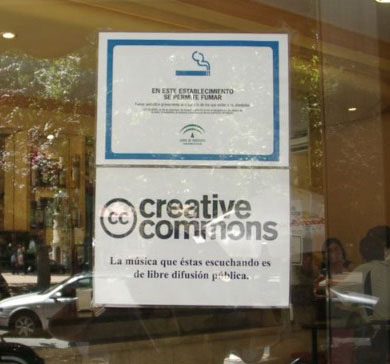
Spanish café loses case on "free music"


A Spanish court in Pontevedra has ruled in favour of the Sociedad General de Autores y Editores (SGAE) against a café named Direccion000. SGAE initiated action against the cafe to claim royalties for de public performance of music in the locale, while the owners claimed that they did not have to pay because they were only using “free music” under Creative Commons licences.

The café lost the case in first instance and appealed on the basis that the locale has several signs claiming that they had permission to play free music in the establishment under the terms of CC licences. However, SGAE was able to prove that the music selection included artists under their representation.

Perhaps the most worrying paragraph from the case is that which describes the legal validity of CC licences presented as evidence. According to the court:

“…it is worth to point out that the document presented by the defendants-appellants as a licence for free use of music does not constitute anything other than a mere informative leaflet about its own content, lacking any form of signature, and therefore bereft of legal value whatsoever”.
I find this worrying because it seems to imply that CC licences are invalid without a signature, which would spell trouble for their legal validity in Spain. I would hope that the court was shown the human readable deed, and not the licence as such.

I do not have sympathy for the café owners as it seems to me that they were playing commercial music while advertising that the locale only played “musica libre”. Still, I am greatly concerned about wider potential implications with regards to CC contract formation (or licence formation where applicable).

Tuesday, December 05, 2006

When the Internet breaks

In the age of broadband, Blackberries, 3G and wireless, we have come to expect 24/7 online access all the time. But what happens when the Internet breaks?

Costa Rica and the rest of Central America are connected to the Internet through two fibre optic cables: Maya-1 and most importantly Arcos-1. The former runs from Puerto Lempira in Honduras to Punta Cana in the Domenican Republic (some maps here). Since last Sunday, the Arcos-1 cable has been down, which has meant that the Internet is either very slow, or not available at all.

This has made me think back on some digital divide issues and the fact that large part of the Internet relies on complex inter-connection agreements for the lease of bandwidth, and that when one of those connections is unavailable, the Internet suffers. If such an event takes place in developed countries with vast inter-connected fibre optical networks, the impact is considerably smaller. However, with countries that rely heavily on one or two main cables for connection, any shortages hit very hard indeed.

The national telecomms company ICE and RACSA, the monopolist Internet Service Provider in Costa Rica, have mentioned that they are likely to sue if the faults where caused by negligence.

By the way, this message reaches you thanks to some other cables, such as the Antilles Crossing.

Monday, December 04, 2006

Troubled CAFTA in Costa Rica

The Central American Free Trade Agreement is the multilateral treaty signed between the United States, the Domenican Republic and several countries in Central America. As it happens with most free trade agreements negotiated by the Bush administration, there is a requirement to impose heavy protection of intellectual property rights in the signatory countries. In most instances, the protection seems particularly unnecessary for developing countries. Why are strong anti-circumvention provisions required in the text? Why the emphasis on implementing criminalisation of IPR infringement?

Anyway, the road to CAFTA has been extremely difficult in Costa Rica. Firstly, the agreement hung in the balance last February at the local elections when anti-CAFTA candidate Ottón Solís almost defeated pro-agreement candidate and now president Dr. Oscar Arias Sánchez. The agreement has also been the subject of heated popular demonstrations from university strudents and intellectuals.

CAFTA (or TLC in Spanish) is now in process of being voted in not in a bulk legislative package, but it has been broken up. IP provisions are now being considered by the plenary, including reforms to the existing IP law, and a new trade mark legislation. It seems to me that the Costa Rican government is trying to sneak some of the least controversial issues such as IP protection before sending the treaty to vote. Let's face it, IP issues do not send people to the streets (unless they are protesting software patents).

Saturday, December 02, 2006

Costa Rica

I'm on my way to the land of Imperial, gallo pinto and lovely beaches. I will still be posting regularly from home.