Tuesday, October 07, 2008

Financial crisis in one picture

As some of you may have noticed, I've been enthralled by the looming financial crisis (is it accurate to call it "looming" after the last few days?) Anyway, here is a gem I found while reading up on the crisis:


Pretty much sums it up.

Monday, October 06, 2008

Language matters

Hiding meaning through obscure language is a long-held tradition, after all, that is what euphemisms are all about. However, avoiding regulated practices by calling them something else is an entirely different matter altogether. Insurance provision is a heavily regulated area for a reason, yet if you do not want any oversight, you call what you do something else and elude the regulators. If you sell insurance, but do not want the pesky regulators looking at what you do, then you call it a credit default swap, and presto, the regulators are gone (sort of like the expecto patronus spell of financial markets).

The world's financial markets are in trouble due to clever renaming. A sad indictment on regulation as a whole? Perhaps I should stop analysing the law and become a linguist. At least my grammar and sentence structure might improve.

Friday, October 03, 2008

Software Cultures Hardware Laws

Last week I attended an interesting event called Software Cultures Hardware Law organised by Queen Mary Intellectual Property Research Institute. I flew in from the frozen wastelands the same day of the event, so I missed a panel called "Meet the Jurists" chaired by Prof. Johanna Gibson and with the participation of Rt Hon Lord Justice Jacob, Mr Henry Carr QC and Mr Martin Howe QC . Apparently, there was discussion of some new game-related software patent case which sounded fascinating (if anyone has heard of this case, please let me know). There were some excellent presentations. Open Source expert Till Jaeger gave an introduction of the anti-DRM clause in the GPL v3. Guido Westkamp talked about international TPM protection. Ross Anderson provided a forceful and compelling argument against further criminalisation of copyright enforcement, and provided historic context as to why it really matters. However, I wanted to highlight a couple of presentations from two experts from the Software Information Industry Association.

Firstly, Scott Bain presented the best legal paper of the day on the issue of first-sale doctrine and its application to copyright law. Unsurprisingly, the SIIA and other content industry lobbyists are usually against first-sale doctrine. For those unfamiliar with it, the first-sale doctrine allows you to resell a CD or a DVD (forgive the dumbed-down analysis). Content owners usually argue that what they do is not a sale of goods, but rather a licence. By licensing the content, you never "own" the intellectual property you purchase, you are only acquiring permission to use it for a while. If you do not own it, you cannot resell it. This allows the market to be split into sectors, and allows software manufacturers to offer cheaper prices to hardware manufacturers, educational institutions, students, developing countries, etc. This OEM software is often resold by distributors at cheaper prices, a practice that has been the subject of countless cases (Vernor v Autodesk, and Wall Data to name a few). I have not given first-sale proper thought, but the fact that it was treated in Blizzard v MDY caught my attention. I have criticised the ruling elsewhere, but I feel that the one thing that the case may have going for it is the fact that it treats software as licensed material and not as a good, so I agree with Mr Bain's take on the subject.

The other presentation worthy of note was Keith Kupfershmid also from the SIIA. While I am an old hand at listening to hyperbolic rhetoric from the copyright lobby, I am still surprised by some of their tactics. Mr Kupfershmid is head of enforcement at the SIIA, and I was truly shocked by the level of his presentation. We were first introduced to the subject of enforcement by presenting us with three bad people. How do we know they are bad? They are pirates. OK, piracy is bad, but how much worse can these people be? Well, the first person highlighted was not only a pirate and sold software on eBay, but when the police raided his computer, they found child pornography! Yes, that's right folks, in one single slide software piracy was effortlessly equated with child molesting. You cannot make this stuff up! The other perpetrators were no better, keyloggers and hackers one and all.

But perhaps the most disturbing thing of the entire presentation was that it was a perfect example of the latest strategy from content owners against intermediaries. Google, eBay and PayPal are involved in "e-fencing", so they are no longer intermediaries, they are "facilitators". Yes, you heard right, they are instrumental in the crimes committed by allowing these evil people access to the market. We have seen that intermediaries are increasingly under attack from content owners, from YouTube to Google, passing though three-strikes. To me the implication of the entire presentation for intermediaries was very clear. So far your liability has been civil, but if you do not comply with our demands, criminal liability may not be far off.

Criminal enforcement, coming to a legislature near you.

Update: The case is Nova v Mazooma.

Wednesday, October 01, 2008

Financial spam

I received this on the mail this morning, and felt the urge to share it.

Dear Grateful in God:

You may be surprised to read this message from me as you do not know me. I need to ask you to support an urgent secret business relationship with a transfer of funds of great magnitude.

I am Ministry of the Treasury of the Republic of USA. My country has had a crisis that has caused the need for large transfer of funds of $800 billion dollars US. If you would assist me in this transfer, it would be most profitable to you. I am working with Mr. Phil Gram, lobbyist for UBS, who will be my replacement as Ministry of the Treasury in January. As a Senator, you may know him as the leader of the American banking deregulation movement in the 1990s. This transaction is 100% safe.

This is a matter of great urgency. We need a blank check. We need the funds as quickly as possible. We cannot directly transfer these funds in the names of our close friends because we are constantly under surveillance and in danger of our lives. My family lawyer advised me that I should look for a reliable and trustworthy person who will act as a next of kin so the funds can be transferred.

Please reply with all of your bank account, IRA and college fund account numbers and those of your children and grandchildren to wallstreetbailout@treasury.gov so that we may transfer your commission for this transaction. After I receive that information, I will respond with detailed information about safeguards that will be used to protect the funds.

Yours Faithfully Minister of Treasury Paulson

Tuesday, September 30, 2008

EndNote sues open source reference competitor

As many other academics, I have come to rely on reference software to keep my bibliographic resources organised. For some time I have been using Endnote because it came installed with University computers, but I have been increasingly frustrated with its lack of interoperability and inflexible interface. EndNote has many things I like, but as my bibliographical files grew, its limitations became more evident. Lately I have been using a combination of CiteULike, EndNote and Book Collector to keep my books organised.

It seems like I am not the only person dissatisfied with EndNote, and the open source alternatives have been multiplying. I have been particularly impressed with newcomer Zotero from the George Mason University. Zotero is a Firefox 3 plugin that allows scholars to manage their references directly from the browser. It is light, interoperable, feature-rich, and extremely flexible. Whichever way you look at it, is much better than Endnote. So, if you are Thomson Reuters (the owners of EndNote), you would assume that you would welcome the competition and would work hard to improve your own product... but why improve when you can sue your competitor out of existence? Thomson Reuters have done just that, and have sued the State of Virginia and George Mason University for breach of licence (complaint here).

What is Zotero's sin? Interoperability! According to the complaint:

"A significant and highly touted feature of the new beta version of Zotero, however, is its ability to convert - in direct violation of the License Agreement - Thomson’s 3,500 plus proprietary .ens style files within the EndNote Software into free, open source, easily distributable Zotero .csl files. [...] On information and belief, GMU reverse engineered and de-compiled EndNote Software and the proprietary .ens style files contained within the EndNote Software in order to determine how to convert the EndNote .ens style files into the open source Zotero .csl style files, in direct and material violation of the License Agreement."
How dare they? They have made it easy for Endnote users to migrate to a competitor! Quick, let's sue the hell out of them!

What are the legal merits of the suit? The licence agreement does indeed have the following restriction:
"2. RESTRICTIONS. End User may not modify, translate, decompile, reverse engineer, retransmit in any form or by any means (electronic, mechanical, photocopied, recorded or otherwise), resell or redistribute the Product, or any portion thereof, without the prior written consent of ResearchSoft. Except as expressly set forth in this Agreement, End User may not make any use of the Product."
Notice that the complaint therefore is for breach of contract and NOT for copyright infringement. I think that the reason is clear, decompilation for interoperability purposes is increasingly an accepted user right (see for example, article 6 of the Computer Software Directive). The question therefore at the heart of the case will be as follows: does the strict wording in EndNote's licence which prohibits the decompilation and reverse engineering of EndNote trump the fair use defence of decompilation for interoperability purposes? It is likely that the case will rest on ProCD v Zeidenberg territory, where the pre-emption of contract law over copyright was discussed at length by Judge Easterbrook. My own guess is that the claim is so tenuous that it will not survive legal scrutiny. As others have pointed out, this is clearly a nuisance lawsuit designed to intimidate a competitor out of the market.

However, researchers disgusted with Thomson's lawsuit should do more. I am uninstalling Endnote from all my computers, and will be converting SCRIPTed's EndNote style to Zotero's interoperable open format as soon as possible. I would encourage other academic EndNote users to make their displeasure felt. Such bullying should not be allowed.


Friday, September 26, 2008

GikIII ends

The third instalment of Gikii (aptly named GikIII) is now over. As with previous years, one is left feeling intellectually stimulated and a bit daunted by the level of smartness emanating from the room. First's year's iconic figure was the killer robot, last year's was the Lolcat, this year it is a knitted sex bot. Yes, you know you have been to a good conference when flying penises and sexbots adorn some of the slides.

It is difficult to choose highlights from the excellent batch of papers. Comrade Schafer presented my favourite paper of the workshop with a look at fan fiction, logic, and DRM in Jasper Fforde's novels. Miranda Mowbray's remix of Sherlock Holmes and cloud computing was both endearingly performed and absolutely spot on. I am thinking of starting the Alana Maurushat appreciation society from her performance last Monday at the University of Edinburgh, and her astute presentation about the disproportionate misuse of copyright law to protect things that are not supposed to be covered under copyright (and any presentation that has a kitten with a sniper rifle meets my seal of approval). Melissa DeZwart's look at fan interpretations through avatars in virtual worlds was another highlight.

However, to highlight just a few papers does disservice to all the others, we had some pretty amazing stuff.

Wednesday, September 24, 2008

GikIII

One of my favourite times of the year has arrived... It's Gikii time!

If you cannot be here the papers are being uploaded as they are presented to this page.

Monday, September 22, 2008

Bubbles bursting, credits crunching, unweaving webs?

I would like to declare a moratorium on excessive use of adjectives to describe the current financial crisis. Why adjectivise (is that a word? If not it should be) when onomatopoeia will suffice?

Zoom! Fzzzt! Eek! Kapow! Kabbloey! Argh!

There, the credit crisis easily explained in one line.

Seriously though, bubbles bursting and credits crunching tend to have one thing in common, and that is the sudden drying up of venture capital as investors reassess their strategies and prioritise towards less risky enterprises. Almost by definition, venture capital investment is a risky endeavour, so it is only natural that in times of crisis, the same investors interested in putting money to support the launch of Pets.com will suddenly think twice and invest in gold.

It is no secret that we have been experiencing a mini dot.com bubble in the last couple of years fuelled by Web 2.0 sites. The success of the likes of Myspace and Facebook has prompted a new generation of entrepreneurs (and the recycled dot.com generation) to try their luck in the market by proposing all sorts of participatory web ideas. Venture capital has been willing to invest in the next Facebook, so technology websites have been springing up like things that sprout up during spring (hence the term I guess). By the end of 2006, venture capitalists had invested $500 million USD is Web 2.0 sites, a figure reputedly doubled by 2007. But the well of investment has stalled in 2008, and I would not be surprised if the figures for the year are depressing for web entrepreneurs (early indications point towards a bad investment year).

The problem with the current bubble is that many of the elements that doomed the first one are still there. Lots of investors go into the market with little or no understanding of the technologies involved, and many entrepreneurs create services that nobody wants, or have such small niche appeal as to make their business models obsolete within three months. Moreover, there is little understanding of how these technologies work. Services like Flickr, Digg, and Facebook do not respond to any rational rules of design or sound business model, they simply succeed by an almost serendipitous accumulation of links. Early comers are well placed to accumulate more incoming links early in the game, and then they coalesce into market leaders almost overnight when numbers reach a certain indeterminable tipping point. This basic understanding of networks would be a good tool for investors.

Another common element with the dot.com bubble is that there is a lot of gibberish and technobabble being passed off as sound business models. By using some essential buzz words, the new crop of entrepreneurs want to make it seem as if they have a grasp of the market, when in fact they are just as clueless about it as the rest of us. Last year's buzzword was "social network", but as the leaders established their dominance, other opportunities needed to be found. This year's buzzwords are "local" and "recommendation site". Yes, some people are just realising that Amazon's recommendation system really works, so they want to incorporate the same thing to their sites. The latest trend seems to be to launch a plethora of services that know where you are, tell you if your friends have been there, and recommend them to you. In other words, a thousand ships launched on the premise of the iPhone! Two words for you. Free apps. Social localised recommendations already exist (Panoramino and Google Earth anyone?), and they will reach their zenith when augmented reality comes our way, but social recommendations are driven by free community social tagging, not by proprietary services.

Moreover, the almost religious optimism of some of the players is breathtaking. I was listening to an interview with Brent Hoberman (of Lastminute.com fame) in the excellent Guardian Tech Weekly podcast, and I was struck by the almost Kool-Aid-drinking quality of some of the statements, such as the admonition that "some of the businesses that failed in 2000 are about to work this time around". Translation: we failed before, but give us more money, and this time we will succeed, even though we are using the exact same faulty business plans and basic misunderstanding of how the web works.

I know that I am just adding my voice to the grumpy technophobes that have been heralding the demise of Web 2.0 since last year, but what the heck. Although I think that Web 2.0 is here to stay, there will be a crash (or maybe even a fizzle), just like back in 2000. Few winners will survive, the rest will go the way of Kozmo.com and their ilk.

Saturday, September 20, 2008

Hacking Palin

An interesting cybercrime and politics story came out this week. Sarah Palin's Yahoo email account was hacked by a group called Anonymous and screenshots were posted in WikiLeaks. Hacking may be too strong a word, what seems to have occurred is more akin to social engineering, as the hackers admitted that they simply guessed correctly Palin's Yahoo security questions. The hacker reset the password by answering Palin's date of birth, postcode and where she met her husband (Wasila High), all easily obtainable facts.

Now the FBI has become involved, as it is a federal offence to have unauthorised access to someone else's email through the Stored Communications Act. The Act makes it a criminal offence to "intentionally accesses without authorization a facility through which an electronic communication service is provided". The perpetrator faces a fine or up to five years in jail if the access was done for "commercial advantage, malicious destruction or damage, or private commercial gain, or in furtherance of any criminal or tortious act in violation of the Constitution or laws of the United States or any State". For any other case, the penalty is one year or a fine. However, the EFF has stated that prosecution may be difficult in case of accessing viewed or opened emails.

While I confess to feeling a pinch of schadenfreude at this case, there is something deeply wrong about accessing another person's email. What seems clear is that privacy settings for famous people are clearly inadequate, as the security questions are anything but.

Friday, September 19, 2008

Happy "Talk like a pirate day"


As a devout Pastafarian, I am obsessed with all things piratical. After all, one of the basic doctrines of the Church of the Flying Spaghetti Monster is that global warming is caused by the decline in pirates. Avast me hearties, 'tis September 19 today, and that means "talk like a pirate day" is back.

Argh!

Thursday, September 18, 2008

The Internet is for Censorship

I still remember how we looked at the Internet in the early days, and how many of us thought that it could never be regulated. Years later, a large firewall and a rather effective gambling ban have proved us wrong. This is why I keep reading every year JPB's Declaration of Independence of Cyberspace... just to remind me that what seem logical now may not look so sane in a decade.

There appears to be a growing trend from governments to try to declare all sorts of things out of bounds by applying different censorship tools. the latest victim has been Richard Dawkins, who has had his website banned in Turkey because a Creationist has found it "defamatory and blasphemous".

There must be an equation that correlates religious fundamentalism with censorship.

On a shallow note (and let's face it, this blog is largely about the pithy and shallow side of the law, is it not?), doesn't the name Harun Yahya make you want to giggle uncontrollably?

Wednesday, September 17, 2008

Palin baby name generator

With names like Track, Trig and Bristol, the world is awash with potential Palin baby names. What would you be named if you were a Palin baby? Now you can find out!

Apparently, I would have been Claw Palin. I like that!

Friday, September 12, 2008

The predictive power of computers

I have always been interested in the depiction of computers in popular fiction. One early computer meme represented the percentage crunching computer/robot that would helpfully tell the protagonists the percentage rate of survival for X situation ("You have a 2% chance to survive that jump").

While computer predictions are not as reliable as their fictional counterparts, they are still used in complex simulations involving anything from climate change to traffic flow. I have been thinking about this for several reasons, including research into networks and because of the latest release of iTunes. The system comes with a recommendation system called Genius. You select a song, and Genius will generate a playlist that "matches" it. I am not sure about the parameters used to generate the lists, but I tried seeding lists with Pat Benatar's "Love is a Battlefield" and New Order's "Blue Monday", and I was quite impressed with the resulting lists. However, trying anything other than Anglo Saxon-centric pop and rock will slice Genius' IQ in half. I tried "Bongo Bong" by Manu Chao, and even several Soda Stereo songs, and all I got was a message claiming that Genius could not generate a list. I was also underwhelmed by the Classical music lists. Apparently, I am not the only person who thinks that Genius is not particularly clever (a hint to Apple: do not name any system with synonyms for intelligence, it will only generate derision from the blogosphere). If you want to try to go into Microsoft world and purchase a Zune, the recommendation system appears to be rather good (I do not know anyone who would willingly buy a Zune though).

Recommendation systems are not new. Amazon's recommendation algorithm has been with us for years, and it really works. It seems like every week there is talk of a new startup that promises to bring social intelligent systems to make our lives easier by letting our friends recommend stuff to us; the Guardian's Technology podcast seems to be almost entirely about social recommendations lately. Similarly, talk about the semantic web and intelligent systems has been around for ages.

I remain sceptical about many of these predictive services, particularly about social applications. While I find it interesting that I share musical tastes with people in my Facebook friends list, I will not make many decisions based on that. I am also sort of troubled about the fact that our tastes can be so easily predicted. I like fooling the system from time to time! Nevertheless, with the advent of the petabyte age, some pictures are starting to emerge. It seems like we make decisions in a more predictive manner than we previously thought. Serendipity and inventiveness are actually rare, and most of us are remarkably simple creatures, responding to the world in a predictable manner.

Can we code these deterministic responses into law? Although I would like to answer no, my logical brain says yes. But what do I know, I have some shameful songs in my iPod.

Thursday, September 11, 2008

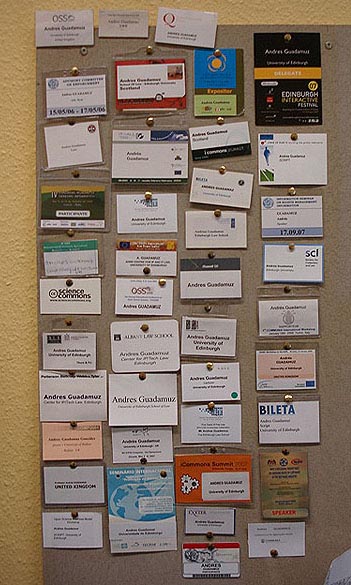
Ontological insecurity

You know you've been to too many conferences...


...when your office wall looks like this.

Wednesday, September 10, 2008

DRM fails. Again.


I am feeling a bit cyclical (and cynical) this week. Amusing copyright case from the States? Check. Scientologists unleashing havoc? Check. Underwhelming Apple keynote? Check. The end is nigh? Check. Perhaps I've been infected by Cascio's cynicism (thanks panGloss).

I've been reading that DRM has delivered us with yet another fail in the shape of the game Spore. Players have been complaining about a system that does not allow users to install more than three times, not even counting uninstallations, or any other emergency backup. When will developers realise that stringent DRM does not work?

Anyway, back to enjoy breakfast before they turn on the Large Hadron Collider. It is the end of the world as we know it, and I feel fine.

Tuesday, September 09, 2008

JK Rowling wins Lexicon case

Edinburgh University honorary graduate Joanne Kathleen Rowling (right) has won her case against Steven Vander Ark, the author of the Harry Potter Lexicon (the site is now down). I have been following this case with interest, as I believe it is a prime example of the growing conflict between traditional copyright owners and fans generating their own content based on existing material. My opinion has been that while content owners are usually happy to allow fans to tinker with the source material, they will sue if the fan crosses the commercial line.

The facts of the case were rather straightforward. Steven Vander Ark maintained the website called the Harry Potter Lexicon for several years, amassing an impressive amount of background information about every single aspect of the Potterverse. The Lexicon proved to be such a good resource that it was reputedly used by Warner Bros in their Harry Potter productions. However, when Vander Ark made a book deal with obscure publisher RDR Books to turn the Lexicon site into a reference tome, Rowling sued for copyright infringement faster than you can say "Expelliarmus". The Lexicon argued that this was a derivative work, a reference based on the original, and therefore fell within fair use.

The U.S. Disctrict Court of the Southern District of New York has now granted an injunction against the Lexicon. The main legal question at the heart of the District Court's reasoning was whether the Lexicon was merely a reference guide to a work of fiction (and therefore a derivative work under American copyright law), or if it lacked originality and infringed JK Rowling's works. The District Court first tried to determine the nature of the Lexicon:

"The Lexicon entries cull every item and character that appears in the Harry Potter works, no matter if it plays a significant or insignificant role in the story. [...] Each entry, with the exception of the shortest ones, gathers and synthesizes pieces of information relating to its subject that appear scattered across the Harry Potter novels, the companion books, The Daily Prophet newsletters, Famous Wizard Cards, and published interviews of Rowling. The types of information contained in the entries include descriptions of the subject’s attributes, role in the story, relationship to other characters or things, and events involving the subject. Repositories of such information, the entries seek to give as complete a picture as possible of each item or character in the Harry Potter world, many of which appear only sporadically throughout the series or in various sources of Harry Potter material."
This seems like an impressive undertaking, with considerable work and thought going into it ("sweat of the brow" anyone?) The District Court agreed that this was akin to the many reference works accompanying other multi-volume Fantasy series, such as The Lord of the Rings and Narnia. However, the court found some problems with the Lexicon, namely:
"Although it is difficult to quantify how much of the language in the Lexicon is directly lifted from the Harry Potter novels and companion books, the Lexicon indeed contains at least a troubling amount of direct quotation or close paraphrasing of Rowling’s original language. The Lexicon occasionally uses quotation marks to indicate Rowling’s language, but more often the original language is copied without quotation marks, often making it difficult to know which words are Rowling’s and which are Vander Ark’s."
The District Court analyses leading case law in the issue of transformative and derivative works (such as Castle Rock Entertainment v. Carol Publishing Group). The District Court agreed with the defendants that the Lexicon conveyed “new information, new aesthetics, new insights and understandings” as defined in Caste Rock. However, the court points out that:
"The transformative character of the Lexicon is diminished, however, because the Lexicon’s use of the original Harry Potter works is not consistently transformative. The Lexicon’s use lacks transformative character where the Lexicon entries fail to “minimize the expressive value” of the original expression. A finding of verbatim copying in excess of what is reasonably necessary diminishes a finding of a transformative use. As discussed more fully in analyzing the “amount and substantiality” factor, the Lexicon copies distinctive original language from the Harry Potter works in excess of its otherwise legitimate purpose of creating a reference guide."
In other words... plagiarism! The Lexicon's undoing may be the very lack of originality displayed by the copy-and paste culture.

While I was naturally sympathetic to Vander Ark and the Lexicon, the injunction is very persuasive in its reasoning. However, it must be noted that American originality thresholds are higher, and I wonder if a different decision might have been reached this side of the pond.

Anyway, Rowling has taken her wand and said Avada Kedavra! The Lexicon drops dead.

Monday, September 08, 2008

Scientology misuses copyright. Again.

Scientology has had a long and interesting history at the courts in using copyright law to remove content which it deems infringes its rights (*cough*censorship*cough*). Scientologists have repeatedly used copyright law in order to remove most references to aliens, Xenu, volcanoes, and DC-10 planes from public debate by alleging that many documents and depictions of scientologist beliefs are actually infringing its copyright.

Now the EFF reports that those whacky scientologists are at it again by issuing several DMCA take-down notices to several channels which criticise scientology.

It is sad that a movement needs to rely on preposterous copyright claims in order to keep what they actually believe from the public. But then again, there is reason to hide the fact that Scientologists believe in Xenu, the alien ruler of the Galactic Confederacy, who 75 million years ago brought billions of people to Earth, stacked them around volcanoes and blew them up with hydrogen bombs. I mean, if word of this got out, they could not charge people for the secret, right?

Thursday, September 04, 2008

Browser Wars and faulty EULAs

The browser wars have just gotten a bit more interesting with the release of Google Chrome. While I am too addicted to Firefox, Chrome appears to be an interesting experiment. However, the Chrome EULA raised some eyebrows, as it contained the following clause:

"11. Content licence from you
11.1 You retain copyright and any other rights that you already hold in Content that you submit, post or display on or through the Services. By submitting, posting or displaying the content, you give Google a perpetual, irrevocable, worldwide, royalty-free and non-exclusive licence to reproduce, adapt, modify, translate, publish, publicly perform, publicly display and distribute any Content that you submit, post or display on or through the Services. This licence is for the sole purpose of enabling Google to display, distribute and promote the Services and may be revoked for certain Services as defined in the Additional Terms of those Services."
Wait a second... this is a browser, right? How on earth did someone at Google figure that they would be getting a licence for content placed on the browser?

Thankfully, the licence has now been ammended to read:
"11.1 You retain copyright and any other rights that you already hold in Content that you submit, post or display on or through the Services."
Crisis averted then, but it must be said that Google's lawyers should have looked at this a bit more closely. Someone seems to be a bit too busy with the Viacom suit.

Friday, August 29, 2008

How to stop piracy?

I think that everyone can agree that one of the problems with piracy is that it may have negative effect on some musicians. There is evidence that the music industry has become more reluctant to sign new acts and is relying on old names to stay afloat; and some small and medium artists have seen their works pirated indiscriminately. While we have become immune to pleas against music downloading from big names in the industry, it seems like the new marketplace is in turmoil. for example, CD sales continue to drop in the States, while they seem to go up in the UK. Similarly, P2P seems to affect established names, while it may benefit smaller acts. Meanwhile, Radiohead continues to innovate with their forward-thinking delivery methods.

What to do? It seems evident that the big stick strategy is not working. P2P enforcement is uneven, it has not stopped infringers, and most importantly, it seems to be targeting innocent users. Similarly, DRM is not the solution (mini-rant: whoever thought that DVD regions were a good idea? I had to spend hours hacking my MacBook's DVD protection to watch a legitimately purchased copy of War Games!).

One thing is clear to me. While in Costa Rica, I have been struck by the vibrant local music industry. Some artists are doing reasonably well for the market, including the amazing Malpaís. While this group is very popular with the download generation, their records are selling remarkably well. Apparently, buying th record has become an important part of being a Malpaís fan. The solution then has not been one of enforcement, it has been one of social awareness. I put forwrd then that the solution to piracy is to empower the consumer, just like Radiohead is doing. There are other schemes to invest in new bands, proving that the solution is in empowering the fan base.

I'm a bit tired, so I will not be issuing a pithy one-liner today.

Thursday, August 28, 2008

Internet memes against copyright term extension

I found this wonderful timeline of Internet memes yesterday, so many happy memories of hours wasted in front of a YouTube screen... but I digress. I have been frustrated by the seemingly unstoppable war on evidence waged by copyright policymakers, a frustration made worse by the nagging certainty that there is nothing we can do to stop term extension. However, watching those internet memes got me thinking about the power of the Internets in conveying ideas in a fun and viral manner.

Therefore, I would like to suggest that we unleash the power of memes in service of the copyfight. Do you oppose term extension? Kill a Mentos! Record it, upload it, blog about it, Facebook it, Flickr it, Twitter it.

I'm off to the shops to buy some diet soda and some chalky mint sweets.