Showing posts with label Meme. Show all posts

Monday, March 16, 2009

UK public sector websites to contain user comments

One of the most useful features of the participatory web and the user-generated revolution is that it allows interaction from consumers (gosh, how do I hate it when I start using journalistic commonplace terms such as revolution, debacle or meltdown). Now the British government is about to jump in the bandwagon, as Gordon Brown announced last week that government websites will allow users to make comments and recommendations. The Prime Minister said that:

"For I believe government has been much too slow to make use of the enormous democratising power of information. People take it for granted that they will access other people’s reviews and ratings before buying something on e-bay or Amazon, and yet we do not yet have systematic access to other people’s experiences when choosing a GP practice or nursery. We have clearly got the balance wrong when online businesses have higher standards of transparency than the public services we pay for and support."
I for one find this to be very good news, it's almost as if the PM has finally realised that we are in the 21st century, and that there are other ways of garnering the public's interest. Wouldn't it be great if you were able to find out if your GP is any good?

Nevertheless, David Mitchell has written an excellent article on yesterday's Observer where he warns about implementing this policy (David Mitchell is UK's version of PC in the Mac ads). He rightly points out that comment sections across the web are often filled with vitriolic and unjustifiably angry posts that have no other objective than denigrate and mock the writer. Do we really want hundreds of comment pages around the country that consist of nothing more than baseless and angry rants about public service staff? This is a good point, as everyone who has spent any time in blogs and internet forums will attest to.

The solution? A new internet meme is born! Mitchell suggest that people should go to any website with a comment function, and should simply write "It just goes to show you can't be too careful!" This bland one-liner should act as a form of soothing counterpart to all the bilious animosity prevalent online.

So you know, it just goes to show you can't be too careful!

Friday, November 28, 2008

Bio in 6 words

Mathias Klang at Wrote tagged me with the six word memoir meme, so I will try to rise to the challenge.

I've always liked the line in Half a Person by The Smiths that says "16, clumsy and shy, I went to London and I", but it exceeds the limit. So I will go for this one:

Milk, juice, beer, rum, whiskey, water.

I'll tag panGloss, Aurelio and Daithí.

Thursday, August 28, 2008

Internet memes against copyright term extension

I found this wonderful timeline of Internet memes yesterday, so many happy memories of hours wasted in front of a YouTube screen... but I digress. I have been frustrated by the seemingly unstoppable war on evidence waged by copyright policymakers, a frustration made worse by the nagging certainty that there is nothing we can do to stop term extension. However, watching those internet memes got me thinking about the power of the Internets in conveying ideas in a fun and viral manner.

Therefore, I would like to suggest that we unleash the power of memes in service of the copyfight. Do you oppose term extension? Kill a Mentos! Record it, upload it, blog about it, Facebook it, Flickr it, Twitter it.

I'm off to the shops to buy some diet soda and some chalky mint sweets.

Wednesday, August 20, 2008

Technophobic memes in the press

One of the recurring themes in this blog has been the popular depiction of technology in the media, particularly in mainstream press. It seems to me that there is a pervasive view of information technology in some sectors of the press, where new technologies are to be met with fear and distrust, and all problems presented by technologies are exposed, inspected, analysed, preached about, and stridently condemned by what I call the shrill technophobic classes.

Examples of this phenomenon are too numerous to mention, but some of my pet peeves are the blame allocated to any web technology for teenage suicides; the belief that games turn kids into violent criminals; the idea that the web is brimming with predators waiting to snatch our children away; and the excessive fear towards the powers of hackers.

Do not get me wrong, some of these fear have some justification. There have been well-documented cases of cyber-predators and groomers operating online; there seems to be a minor correlation between some violent games and aggressiveness; hacker attacks are a worrying threat to e-commerce; and some teenagers use social networking sites. However, I get particularly angry at the exaggeration of these issues in order to push a technophobic agenda that seems to condemn information technologies by distorting the actual threat these issues pose to society. For example, children are more likely to be abused by people they know, so why not direct resources to tackle that? Similarly, if there is some correlation between violent games and aggressiveness, regulators should remember that correlation does not mean causation. It is possible that violent games (and movies, literature, and other forms of entertainment) attract agressive people to begin with.

I also contend that these technophobic tendencies in the media tend to be more present in early adoption stages. The Web went through this stage, until browsing has become a fact of life. New technologies and services are met with similar distrust, Web 2.0 social networks, P2P, and many other internet phenomena have been met in their time with Luddite cries of protest, ony to become mainstream and widely accepted eventually.

I am in Costa Rica and I have been struck by the number and tone of technophobic stories warning worried parents about violent video games and grooming. Some of the depictions of the problems range from the anecdotal to the farcical. Perhaps developing societies such as this are trying to come to grips with the new technologies. It will be interesting to see if these views survive further sophistication.

Thursday, July 17, 2008

User-Generated advertising, double standards and memes

Radiohead has continued going where no band has gone before, and in another ground-breaking innovative marketing and licensing strategy they have released their latest video under a Creative Commons BY-NC--SA licence. House of Cards is part of the already seminal In Rainbows, and it was a video recorded with 3D rendering techniques, no camera was used. What's more interesting is that the data for the video has been made available to the public, so that they can make their own variation of the code and add it to a YouTube group showing user-generated versions. This has already resulted in more than 20 videos and an iPhone applet.

In the cynical age we live in, it would be easy to be sceptical of Radiohead's efforts. After all, Radiohead is an established band with an almost cult-like status and a loyal following that ensures success in almost anything they do. It helps that they are practically the definition of geek cool (they were in the cover of Wired). I will leave my cynicism aside and declare that whatever they're doing, it's working. Radiohead have tapped into the user-generated phenomenon and recognised that the old paradigm is dead, long live the new paradigm. In the age of YouTube, it pays to advertise through YouTube. Paying for commercials in Channel 4 is no longer productive.

I have been thinking a lot about the new media environment as I was watching yesterday the trailers for the upcoming E3. No prizes for guessing which online video delivery intermediary was used to stream the trailers. So, while posting and distributing these trailers is copyright infringement, you will never see a single video developer complaining about all the free publicity they're getting, the buzz they are generating, and the list of comments that follow each YouTube posting. PanGloss often makes the point in her Web 2.0 liability presentations that content owners are extremely keen on viral advertising and copyright infringement when it serves their needs, or when somebody posts something about an obscure show that needs the attention. After all, the one thing worse than being talked about is not being talked about, as Oscar Wilde said.

This is what angers me about the Viacom litigation more than anything else. Content owners are simultaneously using viral advertising, and also suing the intermediaries. User-generated marketing has become the norm in many areas such as gaming, music and TV. Why pay for an expensive advertising campaign when you can let the fans do it for you? Target the outlets smartly, and watch them flock to your content. Every week I get at least one request from video game developers to upload trailers in exchange for cash, not to mention offers by gambling websites to include links to their sites which will be paid. Apparently, this blog has been identified as a potential outlet where gamers hang out (whatever gave them that idea?)

I believe that both the traditional model and the online meme model will survive, I cannot see the old guard giving up that easily their stranglehold on income revenue streams. Nevertheless, traditional outlets will continue to look like dinosaurs, while innovators like Radiohead will continue to rake in the cash and the almost-universal praise.

Monday, May 19, 2008

Machinima for good causes

This is an excellent use of Machinima to illustrate the need for Fair Trade.

Monday, April 28, 2008

Jail for priests over copyright infringement?

I was surprised to find this story on the front page of Saturday's Guardian because it shows the growing importance of copyright questions in the mainstream press. However, I was less impressed with the article's content. The headline tells us that "Polish priests threatened with jail for plagiarising sermons". Quite an impressive claim, and definitely a headline-grabbing topic. Plagiarising priests behind bars, it doesn't get any better than this, right?

Certainly, if the priests are lifting entire sermons from online sources, that is clearly copyright infringement, besides being morally dubious, and potentially a sin if one considers it as theft. However, nowhere in the text of the article there is evidence for the claim that the plagiarising clergy will be thrown into jail. Copyright infringement is mostly enforced through civil remedies, and very rarely there are criminal implications for casual copiers. So, maybe Polish copyright law is different? Polish copyright law punishes with two years of imprisonment for two years for "any person who usurps the authorship or misleads as to the authorship of all or part of the work or performance of another..." So in theory it is possible, but this does not seem like something that would be enforced.

Friday, April 18, 2008

New reasons to buy a Mac

The video speaks for itself. Can you spell "desperation?"

Saturday, January 12, 2008

Seven random things

Mathias Klang has tagged me with the 7 random things meme. While researching this, I found that there are some rules. These are:

  • Link to the person’s blog who tagged you.
  • Post these rules on your blog.
  • List seven random and or weird facts about yourself.
  • Tag seven random people at the end of your post and include links to their blogs.
  • Let each person know that they have been tagged by posting a comment on their blog.
1. I like researching the origin of memes.
2. I spend one month in Costa Rica every year.
3. I've been online since 1994.
4. I love sushi.
5. I am fond of anime's narrative style.
6. I am not good at thinking about random things about myself.
7. I hate making lists.

Researching this particular meme has been a true challenge because a lot of people do not link to the person who tagged them. Nevertheless, I have explored the furthest reaches of the blogosphere, and I think that I have found the original post. In my search for the origin, I have browsed the most inane blogs in the world; looked at backgrounds that would make you want to be colour-blind; listened to such inspirational Christian Western music that I had to turn off my speakers in order to retain my sanity (free web advise: DO NOT embed music on your website); learned more than I ever want to know about scrapping, tatting, quilting, crafting, being a mom in the USA; being a quilting tatting, scrapping mom in Oklahoma; seen more pictures of children than I care to count; and in general amazed at the wide diversity that is the Web 2.0 universe.

One of the things that I enjoy about these trips around the blogosphere, is how much they say about social networks. I reckon that this meme got started in April 2007 by a scrapper, which meant that during a month the meme was self-contained in scrapbooking circles. The meme moved on to Christian mothers, then quilters, then tatters, then inspirational speakers, and somehow it made the jump to academics (I have not been able to find the missing link between quilters and academics), which is how it got to me. More interesting for me is to see how the blogosphere is made up of little islands of interests which may seem trivial to outside observers, but which appear to be self-reinforced. I noticed that there are certain themes that are shared along those clusters, for example, the likelihood of encountering a bright background or a blog with music increases if other blogs in a cluster contain such themes.

By the way, I learnt that if you name your blog "My Crazy Life", it probably means that you are the most boring person in the face of the planet.

Now, I'm tagging Jordan, Nick, Lilian, Ian, Daithí, Nic and Fernando.

Friday, August 31, 2007

Downloading is not stealing

(via The House of Commons) A video parody from the University of Sidney's Law Revue that more accurately depicts the nuances in copyright infringement.


From the video:

Downloading movies is not stealing
Copyright is intangible property
Copyright is a chose in action
You would not depreciate your friend's chose in action
Downloading depreciates copyright
Somewhat
Downloading is against the Law
The (Civil) Law
But it's not like the cops will come
So Don't Do It.
Please.

Wednesday, May 02, 2007

HD-DVD brought down by Web 2.0


Back in January I had reported on the hacking of HD-DVD protection by improper key management. AACS, makers of the DRM protecting the new format, vowed to try to shut down BackupHDDDVD, which is instrumental to some part of the cracking process. At the time I thought it was likely to be the last we would hear about this topic, after all, cracked protection is hardly news, is it? Once the how-to had been posted in Ed Felten's blog, the game was up. Or so I thought...

In order to understand the cracking process, we need to understand keys. Felten explains it best, so here he goes:

"In AACS, each player device is assigned a DeviceID (which might not be unique to that device), and is given decryption keys that correspond to its DeviceID. When a disc is made, a random “title key” is generated and the video content on the disc is encrypted under the title key. The title key is encrypted in a special way that specifies exactly which devices’ decryption keys are able to extract the title key, and the result is then written into a header field on the disc.
When a player device wants to read a disc, the player first uses its own decryption keys (which, remember, are specific to the player’s DeviceID) to extract the title key from the disc’s header; then it uses the title key to unlock the content."

However, January's vulnerability was limited, as it could not decrypt the title's key, it was only a player key, which would be useless by itself. Suggestions were made to have a title key database that cracking software could access, but as far as I know it was not implemented. That was the state of play until yesterday, when a key was released to the public which allegedly can be used to decrypt most existing titles. Apparently, this is a processing key, something akin to a master key. I have not been able to find the first source of the key, although some sites have posted a link to a removed WordPress blog here. The earliest post I could find in this meme is here. Perhaps in the days of Web 2.0, it is impossible to find sources. Anyway, what we know for sure is that someone posted this somewhere (vagueness is also very web 2.0):

"Spread this number. Now.
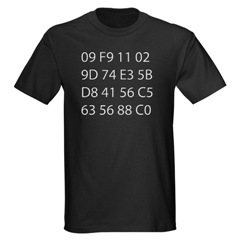
09 F9 11 02 9D 74 E3 5B D8 41 56 C5 63 56 88 C0. It's the HD-DVD processing key you can use to decrypt and play most HD-DVD movies in Linux. Movie studios are going ballistic over this leak, so Digg the story up and make it reach the front page."

This was like DeCSS all over again, but this time with blogs, YouTube, Digg and the whole force of a meme-churning machine. In other words, AACS does not stand a chance. That doesn't mean they did not try! Apparently the number made front page of Digg, who then received a Cease & Desist letter and decided to remove the stories and even cancel user's accounts. Needless to say, the slightest whiff of censorship sent the copyfight warriors on overdrive, and we had a t-shirt (pictured), replication in countless blogs, and even a song uploaded on YouTube. Some of the discussions in Slashdot and Wired have been worth reading as sociological examples of slighted self-righteous geekdom. I can imagine this repeated in chat-rooms across the world:

"Replicate this number, it allows you to copy your HD-DVDs"
"But, I don't own any"
"Doesn't matter man, they're trying to censor us!"

Digg realised they were losing the good will of geekdom, so they posted a "we hear ya", together with the dreaded number on the title. They have decided to "go down fighting" and side with the rebelling masses.

I may be forgiven for being my cynical self, but I must admit that I'm getting slightly suspicious about this whole affair, I'm missing some very basic information in order to make sure that this is a legitimate issue. Here are some problems that I have with the news:

  1. Where is the original post? Has it really been taken down?
  2. The earliest key replication seems to come from a meme post designed to anger the masses. No, you cannot copyright numbers, but keys may be protected as part of an effective technological protection measure.
  3. AACS has not made any official declaration that it's pursuing infringers, something that they have done in the past.
  4. I would like to see Digg's cease-and-desist letter, it seems to me like lawyers for the industry moved incredibly fast.
  5. There's something about the whole story that smells like urban legend to me. The meme has spread too fast in order to get accurate information.
  6. Has anyone actually tried to use the key?

It's possible that my suspicions are misplaced. If that is the case, AACS may have committed the biggest blunder by trying to suppress the key; the level of dissemination is such that it will be impossible to recall it. This may prove to be a case study of how useless cease-and-desist may become in the Web 2.0 era. Even if the story proves to be a clever hoax, copyright owners should heed the lesson.

Update. Some interesting replication strategies from David Berry:

But I still haven't seen any first-hand report that anyone has actually used the key to crack an HD-DVD.

Update 2: Chilling effects has posted the AACS C&D letter to Google, so I guess that makes it official, the key seems legit. If AACS wants to take it down, there must be a reason.
"Ladran Sancho, señal que caminamos".

Update 3: Fred von Lohmann from EFF has posted a warning against posting the key.

Friday, April 27, 2007

Not an IP Day post

Because I have the strong psychological urge to be different (or at least different-ish), I'm trying to make today the "Non-IP Day", seeing as yesterday was "World Intellectual Property Day".

We need a snazzy name though.

Saturday, March 24, 2007

Defining YouTube culture in one OKGo


Copyfight has a good post about the OKGo phenomenon. OKGo, for those who don't know, is a band from Chicago that could be largely classed as alternative, but it may well be part of the new geek rock. What makes OKGo unique is that they're a Web 2.0 band, having embraced YouTube and the YouTube generation. This geek-savy has catapulted the band to geek fame and they're officially an online phenomenon, perhaps achieving similar iconic status as the I Love You guy, All Your Base Are Belong To Us, and the Numa Numa dance. OKGo's brilliant videos are a definition of the Web 2.0 do-it-yourself ethos. The videos are freely available online in YouTube, such as the wonderful Here it Goes Again, and my favourite, Million Ways.

The videos have spawned hundreds of fan interpretations of their favourite band. After all, nothing much is needed to replicate this, only four people with lack of self-consciousness and a video-recording device. Upload it to YouTube and you have a bona-fide Internet phenomenon. Look at the first version and the second of the fans interpreting the Million Ways choreography.

Perhaps I'm dazzled by the hype, but to me there is something deep happening here that goes beyond geeky teenagers embracing a fad. While this may have many interesting implications to media, new media, free culture and how we view our content, phenomena like the OKGo videos exemplify why I believe strongly that Viacom has made a mistake by suing YouTube and Google. Viacom made handsome profits from two shows that are a success because of YouTube: The Daily Show and The Colbert Report. There is considerable danger for Viacom that these two products will become tainted by the suit, and loose their edge and "coolness" factor. Viacom are like Metallica during the Napster trial. Metallica may have been right in legal terms, but they became associated with the establishment, lost their edge, and have not recovered since.

Whatever one may think about the legal arguments in Viacom v Google, there is the true danger that a Web 2.0 revolution against the media conglomerate could spell disaster for them. I smell a settlement somewhere.

Thursday, January 04, 2007

Five things you didn't know about me

I've been tagged with the latest memetag to take over the blogosphere. Pedro Canut from Blogospierre has tagged me, prompting me to list five things that you don't know about me. I don't like talking about personal things (other than travel), but here is a list with mildly amusing factoids about me:

  1. I used to DJ professionally in Belfast (yes, I actually got paid to do it). One night I met and played for Antonio Fargas, the original Huggy Bear from Starsky & Hutch.
  2. I am ophidiophobic.
  3. I was once held hostage at gunpoint during an assault in my family home in Costa Rica. My brother shot one of the gunmen and we escaped unharmed.
  4. I'm writing a novel called "El Ataque de las Chicas Kamikaze".
  5. I once tried online dating, but found the episode frustrating, infuriating and downright scary.
Now I tag the IPKats I know (Jeremy, Ilanah and Jo), The House of Commons staff (Abi, Ben, and Catherine), David Sasaki, Luke Razzell, and Becky Hogge.

Because I cannot just leave this meme alone, I've done some research to find out where it started. At first I thought that it would be difficult (if not impossible) to backtrack it, but after spending one hour following old posts, I managed to find the original (by the way, the blogosphere is a very large place, filled with rather weird people). Perhaps I should add to my list that I get very proud when I do geeky stuff, but everybody knows that.

Anyway, the original post comes from a blog called "Dipping Into The Water Butt" by a woman in the UK. It got picked up by her friends, and the rest is history. I did find a paragraph that was supposed to be kept, but it has been lost somewhere along the way:
PLEASE LEAVE THE FOLLOWING IN ALL POSTS
'Remember that it isn't always the sensational stuff that writers are looking for, it can just as easily be something that you take for granted like having raised twins or knowing how to grow beetroot. Mind you, if you know how to fly a helicopter or have worked as a film extra, do feel free to let the rest of us know about it.'
This would make for some excellent research on the scale-free nature of the blogosphere.