Tuesday, June 19, 2007

iSummit in pictures

Here's my iSummit in pictures (check out the iCommons Flickr stream):


Not a bad place to hold a conference


Badges? We don't need no stinkin' badges!
(courtesy CreativeCommoners)


So, THAT is how he does it!
(courtesy Joi Ito)


Snowclones are the new black
(courtesy Mathias Klang)


Tessi disagrees with me about the quality of the talk


Two children down, about two billion to go


I haven't been this excited since I bought my Mazinger t-shirt!
(courtesy Joi Ito)

Monday, June 18, 2007

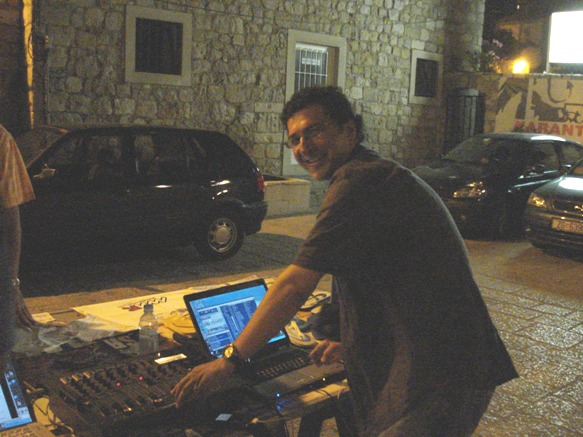
Free Radio

(photo courtesy of Becky Hogge)

One of the coolest activities I managed to do during the summit (besides annoying random people with rants about contract law) was to participate in the Free Radio broadcast. As you can see, it is a radio broadcasting outside one of the venues. I managed to play a Latin set (Fabulosos Cadillacs, Molotov, Juanes and Manu Chao) and as you can see from the picture, the crowds loved it... well they were gathered in the picture's blind side, yeah, they were, truly!

Creative Commons movement

A common theme running through the summit has been the question of the nature of the Creative Commons organisation. Is it a movement? And if so, what is its philosophy? Ideology? Is it political?

I think that these are important questions, and while I believe clearly that this is a movement, I tend to be rather more sceptical about its political and ideological implications. The fact that "we" are now back in the FSF's good books (at least a couple of the licences are), leads me to believe that there is a united front on free or open licences. I would claim that there is clearly a wider philosophical movement dedicated to the generation of digital conservation spaces protected through legal instruments enforceable in court. However, the movement is not a legal movement as such, it simply uses copyright licences as an implementation tool.

This is why the reason why the underlying philosophy is so important. Yochai Benkler agrees that there is a counter-movement exemplified by an opposition to IP maximalism, which is clearly opposed to software patents, increased copyright terms, criminalisation of infringement, new sui generis rights, and other important issues.

Those are worthy causes, but does joining a cause make one a movement? I keep thinking that we need some strong direction, a manifesto for the digital age.

Off to catch a plane now.

Saturday, June 16, 2007

Poker

Venerable (I sort of hate that word, but I don't know how else to describe him) Harvard Professot Charlie Nesson gave an excellent talk on poker and democracy. I'm sure this will be one of those events which will be part of the many excellent talks we have been seeing in the last few days, particularly because Professor Nesson is here after an operation, so we had to go to his hotel and had a session in a 5 star hotel lounge talkinga bout the online poker ban and the law.

Professor Nesson has a theory that poker is a game that teaches about life, about thinking for oneself, independent thought and strategic thinking on specific situations. It is relevant for the law because it is not about lying, but the minor deception involved in bluffing is all about a recognised excercise of risk. The ban on poker is tantamount to an attack on democracy (he did not put it in those terms, but it was implied on the discourse).

Some interesting discussion followed, talking about the benefit of the metaphor, about the specific developments on the American online gambling ban, and about regulation of such practices.

The future of the Commons

Last night Larry Lessig and Jonathan Zittrain presented what I'm sure will become a legendary session on the future of content and the future of the Commons.

Jonathan Zittrain gave a thoroughly enjoyable presentation related to his work on the Web's famous network vulnerability, and what it means for the future of the internet and for the future delivery of content. Zittrain's final points related to the fact that there appears to be a devolution of content provision by technologies that are more analogous to the old BBS services. Similarly, there is a growth in the creation of gated sharing communities instead of the wide and vastly open sharing P2P networks. I was happy to see this expressed in such a manner, I have personally believed that the next generation of "sharing" has been coming back to what I call the "tree house" model, where membership is by invitation only.

Zittrain's presentation was amazing, but something kept nagging me about it, and when I got back to the hotel it dawned on me that it was not specific to the talk, but to the summit in general. There has been a certain American-centric slant on the summit. We have been hearing a lot of American speakers, talking about American practices, American technologies, American websites, and American devices. There is also a certain absence of recognition that other people in the world do things differently. For example, in Africa the devices spoken about are practically unheard of, while the mobile rules the waves. There is also a bit of over-exposition of Western and American cyber-culture and American law. We need to recognise that this is a global summit, and that people do things differently in other places (the exception has been Jimmy Wales, who presented a candid and honest look at global educational projects).

Lessig's talk was a tour de force. I have seen him speak several times, and I honestly thought that I had become used to his presentation style, I didn't think that he could amaze me the way he did last night. The talk was frank, forceful and honest, but most importantly, it was passionate. Lessig has announced that he will be taking a lower-key role, and that it is up to us, the members of the movement to take the brunt of the responsibility in promoting it. He received a standing ovation, and there was a certain buzz after it was over, I think that people were aware that we had witnessed something different.

Jamie Boyle is announcing CC Learn, and Yochai Benkler will give his keynote tonight. I can hardly wait.

On the social front, I went back to the hotel early. Too much international liquor on Thursday night!

Friday, June 15, 2007

F.U.D. from Chile

On the same day that friend and colleague Claudio Ruiz has given me an excellent t-shirt and stickers from the Creative Commons enforcement case in Chile (pictured), I have read some F.U.D. from that same country. It's amazing how some people see CC as a fundamental challenge against proprietary models and have to resort to all sort of methods to raise fear and uncertainty about its adoption.

Thursday, June 14, 2007

Legal Day


We've had some excellent discussion on the first day of the conference, which has been an unofficial start before the summit fully begins tomorrow (in other words, licence geeks get together and throw around ideas).

The first session was an extremely useful description from Lucie Gibault and Paul Keller of the re-licensing issue experience in the Netherlands, which has already ported the 3.0 licences into a Dutch version (but has not been launched yet). We received a set of instructions, tips and recommendations to project and legal leads on how to incorporate the v3.0 changes. Mike Linksvayer also presented instructions and updates on the technical aspects of the licence.

The second session brought an amazing paper from Giorgios Cheliotis, who presented a statistical analysis of the actual licence usage, particularly the ported licences. I will link to the paper when I have access to it. Mike Linksvayer also gave a great run-through some of the statistics, made relevant by the fact that national jurisdictions are not particularly popular, which places things into perspective.

The third session started some of the fireworks. I presented on enforcement, one of my favourite topics, where I spoke about contract formation problems. I was pretty intimidated by the fact that I was speaking after Lessig, who is always his amazing self. To me, the most important piece of news of the entire day was that Creative Commons is now back in the list of "Free Licences" published by the FSF. Comments on this session were provided by Lawrence Liang and Ronaldo Lemos.

Mireille van Eechoud presented an excellent introduction to International Private Law issues, which prompted a lively discussion on whether CC is a contract or a licence. This generated a clear split between common law and civil law systems, with all of us from civil or mixed jurisdictions stating that of course the licences are contracts, with the common law systems disagreeing. Most of us walked away like Galileo, muttering "but it is a contract!"

Paul Keller and Melanie Dulong de Rosnay gave their now yearly report on collecting societies, followed by a very brave David Uwemedimo from CISAC, who presented a very balanced view on where collecting societies stand with regards to CC. I'm sympathetic to people who present to a hostile audience, so I think David did quite well, although I disagreed strongly with his view of creativity. One of my favourite memes is about how the Internet and user-generated content is the result of new sharing ethics online, where CC would be the licence of choice for those at the end of the Long Tail. To think of creators as only those who make a profit or make a living of their creators is entirely wrong in my opinion. We are all creators, even those of us who make their poor musings on their pyjamas every morning.

On the social front we had an excellent night where everyone brought liquor from their countries of origin, which means I'm not feeling at my best today (and from the comments received this morning, I don't look too good either).

Update: Carolina Botero made a very complete and competent report (in Spanish).

Live from Dubrovnik

And the summit begins with the legal day, there will be plenty of discussion on all licensing legal topics, so today is lawyer's day.

The great thing about annual conferences is that you get to see again your friends from last year, and in the words of one of the organisers, you get to see how much people have aged in the last couple of years (and undoubtedly, people get to notice how much I've aged).

Tuesday, June 12, 2007

Croatia

I'm off to Croatia to the iSummit '07. If last year's Rio Summit is anything to go by, we can expect lively discussion, excellent presentations and the gathering of a truly multinational audience. I hope to blog the event, so expect regular updates, wi-fi permitting of course.

Torrentspy ordered to track visitors

The popular torrent site TorrentSpy has been ordered by a California court to track its visitors as part of a suit initiated by the MPAA (WARNNG: TorrentSpy contains pictures of bouncy females in various stages of clothing). According to TorrentSpy's site:

"We have spent the last year challenging their relentless campaign against the 1st Amendment and personal privacy laws Worldwide. We have succeeded in delaying the court order to turn on logs while we appeal it. TorrentSpy will not create logs of what you do on the site without your consent."
It is interesting that the suit against TorrentSpy is about secondary infringement, it is clear that the industry cannot make the case that Torrent tracking sites are the direct infringers. It may also come about making items available to the public via links to trackers, but this will be open to debate. I have placed a copy of the magistrate's order here (courtesy of Fred von Lohmann). This will be definitely one to keep an eye on.

Saturday, June 09, 2007

Name that llama

Former student Linda Wilbraham has sent us a mascot llama (pictured). Colleagues at the office have suggested that it needs a name, so I have decided to initiate a competition to name that llama. You can either write a comment with your name and the suggested llama name, or send an email to technollama at gmail.com. The deadline is June 20th.

Three entries will be short-listed by a third party (I have yet to decide who will make the final decision). The winning entry will receive a £30 GBP Amazon Gift Certificate (or equivalent in your local currency); or a £40 GBP donation to the charity of your choice (I cater for both the selfish and the selfless).

Get creative and make your suggestions soon!

Friday, June 08, 2007

Class-action suit for virtual gold farming

(via Terra Nova) I missed this one during my travels, but I find it such a great story. A Florida law firm has initiated a class-action suit against Internet Gaming Entertainment (IGE), a gold farming company based in Hong Kong and Delaware. According to the plaintiff, one Mr Antonio Hernández, he "spent hundreds of hours" playing World of Warcraft, spent $100 USD on the game and game expansion, and spent $15 USD per month on subscription fees. According to Mr Fernandez, this constitutes a substantial investment on his part on the game and its mechanics.

His argument is that IGE and other gold farmers act against the terms and conditions specified in WoW's EULA and Terms of Use, which specify that the user may not sell items for real money outside of the virtual world. IGE uses gold farmers from developing countries, who are paid to collect the gold, which IGE will then sell for "real" currency. The current exchange rate for 11,000 gold in WoW is $ $1,425 USD. Yes, you read correctly, more than a thousand dollars. Similarly, a Level 60 Female Night Elf Hunter with weapons and mount is sold for $279.99 USD in a European server.

Similarly, the plaintiff claims that IGE has sold virtual gold for millions of dollars, and that the amount of gold on sale is such that it creates a tangible economic damage to "honest" players because it devalues the currency and their own their efforts, it reduces the amount of virtual goods available to them, and it also places their characters at a disadvantage in PvP, because they are not willing to purchase powerful items through the farming system.

Although I find these claims spurious, there may be something to be said for the economic effects of farming. If resource drops are limited, as claimed by the plaintiff, then farming would certainly have severe economic consequences in the virtual world. However, if item and loot drops are instanced per kill (as in City of Heroes), it would not matter how many people are farming resources, you would all have a chance to get a drop because the system works on percentages. In City of Heores you are more likely to receive rare items by killing bosses than minions, and some special missions are guaranteed to produce a rare recipe upon completion.

My question is, what sort of gamer would purchase virtual gold? Where's the fun in that?

Thursday, June 07, 2007

The Genesis of We7

The BBC reports on a new download service started by Peter Gabriel called We7 (wet in l337, geddit?) The service allows free downloads but includes a small advert clip to each songs of up to 10 seconds.

This seems like a good effort, but I'm not sure about its prospects. It is further evidence that the smarter parts of the music industry have realised that the business models have changed.

Monday, June 04, 2007

File-sharing promotes terrorism

The International Federation of the Phonographic Industry (IFPI) has published music piracy's "10 inconvenient truths". Jumping on about three or four bandwagons at the same time must be taxing for the good folks at the IFPI, but I digress.

The list is (with some fisking added):

"1. Pirate Bay, one of the flagships of the anti-copyright movement, makes thousands of euros from advertising on its site, while maintaining its anti-establishment “free music” rhetoric."
Not true, PirateBay does not promote free music, they promote self-serving piracy. The IFPI should understand that people are sophisticated enough to know that pirates are selfish, back-stabbing drunkards who say "argh" a lot. We've all seen Pirates of the Caribbean!

"2. Allofmp3.com, the well-known Russian website, has not been licensed by a single IFPI member, has been disowned by right holder groups worldwide and is facing criminal proceedings in Russia."
In other breaking news, water is wet and snow is cold...

" 3. Organised criminal gangs and even terrorist groups use the sale of counterfeit CDs to raise revenue and launder money."
From P2P, to dodgy Russian sites, to organised crime and terrorism in three steps. That must be some sort of record. Remember kids, when you download songs, you assist Osama Bin Laden.

" 4. Illegal file-sharers don’t care whether the copyright infringing work they distribute is from a major or independent label."
True most of the times, although in my experience music fans are sophisticated enough to support struggling bands they like.

" 5. Reduced revenues for record companies mean less money available to take a risk on “underground” artists and more inclination to invest in “bankers” like American Idol stars."
The music industry has never really been aware of irony, but it does strike me particularly lovely that here it complains about its own bias and emphasis on easy-money, while asking for sympathy.

" 6. ISPs often advertise music as a benefit of signing up to their service, but facilitate the illegal swapping on copyright infringing music on a grand scale."
This one sticks out in this list. It is not a dig directed against P2P and file-sharers, but it's part of an ongoing intermediary liability war. Pangloss should have something to say about that.

"7. The anti-copyright movement does not create jobs, exports, tax revenues and economic growth – it largely consists of people pontificating on a commercial world about which they know little."
If all your efforts to stop file-sharing fail (the pleas from artists, the angry lawsuits, the DRM), then revert to a level of right-wing rhetoric that would fit quite well in Fox News. Only The Industry creates jobs, all of you pinko-commie hippies do not generate anything for the economy. And you're stupid.

"8. Piracy is not caused by poverty. Professor Zhang of Nanjing University found the Chinese citizens who bought pirate products were mainly middle or higher income earners."
Look at the nice straw man being erected. See it knocked down. This is not a logical fallacy for nothing.

"9. Most people know it is wrong to file-share copyright infringing material but won't stop till the law makes them, according to a recent study by the Australian anti-piracy group MIPI."
So, we'll just sue you into oblivion until you comply! We have lawyers and we're not afraid to use them!

"10. P2P networks are not hotbeds for discovering new music. It is popular music that is illegally file-shared most frequently."
Could it be because new music is *gasp* often shared for free?

All in all, a poor showing for the IFPI, even below their stridently inadequate standards.

Sunday, June 03, 2007

AACS keys cracked. Again.


Nothing demonstrates the futility of DRMs arms like the HD-DVD fiasco. Ed Felten has posted about the latest crack on the latest patch of the failing security system used to protect high definition discs. After the now infamous key number was cracked last month and publicised last month, the solution has been to blacklist some keys and update players with the blacklist. But as soon as one key is blacklisted, another crack is sure to follow.

The problem for AACS and similar technological protection measure providers is that they are fighting a hopeless arms race against hackers, regardless of what anti-circumvention legislation says. The Internet community will go to great lengths to publicise anything that seems to be an act of "repression", including a person tattooing the AACS key on himself.

Yes, the Interwebs is a strange place full of whacky people willing to tattoo circumvention of effective techological measures on themselves. The war is lost, change!

By the way, DRM free music available on iTunes! I've purchased my first DRM-free iTunes album, although apparently the music is tagged with the purchaser's name and email.

Wednesday, May 30, 2007

Trouble with Facebook

I'm still not sure about the whole Facebook thing, but this is a video that makes me think twice about the whole endeavour.

One of the interesting legal issues raised is indeed correct (read the terms of use). By posting on Facebook you are granting the company:

"By posting User Content to any part of the Site, you automatically grant, and you represent and warrant that you have the right to grant, to the Company an irrevocable, perpetual, non-exclusive, transferable, fully paid, worldwide license (with the right to sublicense) to use, copy, publicly perform, publicly display, reformat, translate, excerpt (in whole or in part) and distribute such User Content for any purpose on or in connection with the Site or the promotion thereof, to prepare derivative works of, or incorporate into other works, such User Content, and to grant and authorize sublicenses of the foregoing. You may remove your User Content from the Site at any time. If you choose to remove your User Content, the license granted above will automatically expire, however you acknowledge that the Company may retain archived copies of your User Content."
The "get out clause" is of course to close the account, but they will retain copies of the content nonetheless. I must not be the only person who finds this troubling.

Furthermore, here is a funny legal conundrum for you. According to the above, I'm granting Facebook a licence to use the work because all of my posts from my blog are sent to Facebook, but my blog is published under a Creative Commons licence. Which prevails?

Friday, May 25, 2007

Fairytale use

Absolutely brilliant video. Watch some unexpected characters explaining the basics of copyright law. In a faraway land...

Thursday, May 24, 2007

Travel

I will be travelling to Sri Lanka, Spain and Croatia over the next few weeks, but I will try to update the blog whenever possible, wireless weather permitting.

Forever Copyright

(via David Berry) The New York Times has published the most misinformed article on the copyfight that I have ever read, and believe me, I have read some humdingers! The premise is simple. Great ideas last forever, right? So, why should not copyright last forever as well? Property rights do not expire when you die, so why should copyright?

I wish I had the time, the talent, and the inclination to give this article its well-deserved thrashing. Perhaps a few ideas will do. To show my contempt, I will even enumerate my criticism in the lowliest format known to man, the bullet point!

  • For the thousandth time, intellectual property does not equate real property. Ideas are intangible, non-rivalrous goods. With ideas, you can have your pie, and eat it too!
  • Repeat after me, copyright was not designed by the framers of the American Constitution. Google "Statute of Anne".
  • When a work goes into the public domain, it is not "expropriated" by the State, it simply is not awarded protection any more.
  • So, your poor starving grandchildren may not be able to profit from your work 70 years after death. They may have to *gasp* find jobs! Or here's a novel idea, they could find lost notes from granddad's works and release a new book under his name!
I better stop before my pancreas goes into over-drive.

Update: Check out Lessig's wiki against Helprin's article.

Tuesday, May 22, 2007

Fraud law used to fight P2P

(via Suw Charman) A man in London has been arrested for being the UK's representative of AllofMP3, the Russian infamous for selling subscription services at a fraction of "legal" downloads sites, but that does not pay royalties to artists.

According to the IFPI, the arrest is part of a growing set of actions against the site, which include IP blocking, and denial of credit card transactions for purchases on the site. While I have no sympathy whatsoever with AllofMP3, I find the legislation used to arrest this man quite an interesting change in strategy for the copyright industry. The man was not arrested under copyright enforcement legislation, he was arrested under fraud prevention, namely section 2 of the Fraud Act 2006. This section reads:

"Fraud by false representation
(1) A person is in breach of this section if he-
(a) dishonestly makes a false representation, and
(b) intends, by making the representation-
(i) to make a gain for himself or another, or
(ii) to cause loss to another or to expose another to a risk of loss.
(2) A representation is false if-
(a) it is untrue or misleading, and
(b) the person making it knows that it is, or might be, untrue or misleading.
(3) "Representation" means any representation as to fact or law, including a representation as to the state of mind of-
(a) the person making the representation, or
(b) any other person.
(4) A representation may be express or implied.
(5) For the purposes of this section a representation may be regarded as made if it (or anything implying it) is submitted in any form to any system or device designed to receive, convey or respond to communications (with or without human intervention)."
The original press story is wrong, the arrest is not about licensing music, it's about fraudulent misrepresentation. The above criminal offence also applies for online communications, and it seems a fair enough fraud-prevention type, if you misrepresent for your own commercial gain or to cause loss to another, you will be commiting a crime. This particular case applies to Allofmp3.com because the Russian site states that it gives money to artists, which does not seem to be the case. This is false representation in accordance to the above, and therefore the site's London representative can be held criminally liable.

As a wider implication, it seems like people should be careful about what they post online.