Friday, July 13, 2007

Virgin Australia using Creative Commons content


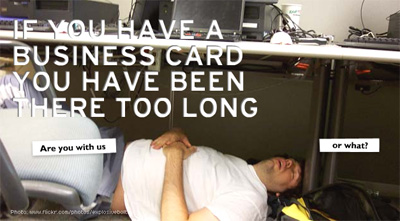
(via Rebecca Kahn) The Icommons mailing list has been discussing another potential Creative Commons enforcement case, this time in Australia. Virgin Mobile Australia has started an advertising campaign called "Are you with us or what?", which has been collecting images from Flickr released under a CC-BY licence, which allows commercial re-use and modification of the licensed work. The images contain comments which could be construed as being insulting and derogatory, as the one displayed here. Needless to say, this has angered some people (displaying my penchant for understatement once again). How dare Virgin Mobile misuse CC licences in such way? Some bloggers have placed the fault squarely in Creative Commons' lap, as they argue that this campaign's subjects were not made to sign model release forms, which I guess is the manner in which Australian modelling agencies deal with image and personality rights.

There is plenty to discuss here. It is true that Creative Commons does not deal in any way with image and/or personality rights. As many pointed out in the mailing list discussion (nod to Andrew Rens), Creative Commons offers copyright licences that do not deal with other areas of the law. While image rights are not something I know a lot about, it is clear that this is an area dealt separately by other type of legislation. One cannot expect the thousands of people uploading images into Flickr and Facebook to ask their subjects for model release forms, or any such nonsense.

It seems like Virgin may be safe in this case with regards to copyright claims, as the images contain a small link to the original photo stream (for example, the one pictured above can be found here). However, there are some other licence elements in which Virgin may be in breach of the terms and conditions. It was also mentioned in the list discussion (nod to Herkko Hietanen) that there is an obligation to place a copy or link to the licence on any modified works, which is not done here. I would also argue that the resulting campaign is being released as a Flash animation, which may (or may not) fall foul of the restrictions against technological protection measures.

Similarly, I believe that Virgin is not exempt of misuse of the subject's other rights. I believe that in Europe there could be a case to be made with regards to Data Protection as the pictures could be used to identify the data subject. It is also clear that the captions could be considered defamatory and/or derogatory, which could be litigated regardless of the copyright case. And there is of course the right of image, wherever that may exist.

While a lot of people oppose non-commercial clauses in Creative Commons, I must say that it is cases like the one I'm describing which proves the point of the popularity of such licence elements. There is now a Flickr group dedicated to collecting the images used in the campaign. One of the comments left in the group's message board pretty much sums it up: "ooh, that sucks. :/ I switched my license a while ago to no commercial use. Glad I did!"

Freedom advocates, take note.
Thursday, July 12, 2007

SCRIPT-ed books for review

SCRIPT-ed is looking for reviewers for three books. These are:

  • Roger Cullis, Patents, Inventions and the Dynamics of Innovation: A Multidisciplinary Study.
  • Charlotte Waelde, Hector MacQueen (eds), Intellectual Property: The Many Faces of the Public Domain.
  • Tarleton Gillespie, Wired Shut: Copyright and the Shape of Digital Culture.
If you're interested, please email Wiebke Abel, our Books Review editor.

Wednesday, July 11, 2007

Virtual lawsuits

Internet news websites have been commenting on a copyright infringement case involving sex toys in Second Life. With spectacular titles like "Sex Toy IP Scandal Rocks Second Life", one would imagine thousands of depressed avatars shocked by the news of a lawsuit involving sex toys. The lawsuit involves something called the "Eros SexGen Platinum Base Unit", a sex toy that only works in Second Life (at this point my imagination decides to take a coffee break). Kevin Alderman, inventor and CEO of the company "making" such devices, has filed a copyright infringement suit in the U.S. District Court in Tampa, against a virtual persona called "Volkov Catteneo", who is apparently selling similar devices.

I will resist the temptation to hypothesise about the type of people who: a) would invent sex toys for exclusive use in a virtual world; b) sell them; c) buy them; d) care enough about the fate of their sex toy to sue someone else for alleged infringement of said device.

Despite the mirth-inducing elements of the suit (and let's face it, this story has "comedy value" written all over it), there could be some interesting legal elements to this. Firstly, there is the copyright claim itself, as I do not envy the judge who will have to decide on the originality of virtual sex devices; perhaps there are not many ways in which one can invent a pixelated toy, I guess that it would depend on the function (there goes my imagination again!) Secondly, what are the implications of suing an avatar? I'm aware that the avatar is just a way to represent a person who will be identified at a later date, but I still find it interesting that the Second Life nickname is the one present on the legal documents.

Alt Text has some great commentary about potential future lawsuits. My favourite is:

"Douglas Anders of Bellefontaine, Ohio, files suit against Thanatog, a warlock from Goldshire, Elwynn Forest, Azeroth, Bloodhoof Server. The suit alleges that "the defendant did knowingly and willfully, without lawful authority, aggro about 30 goblins in the Deadmines, preventing plaintiff from finishing the instance and retrieving the Cape of the Brotherhood, causing mental anguish and loss of wages..."
Given some recent developments, that is not so far-fetched after all...

Update: Ray Corrigan pointed out that I had a Freudian slip, calling it "Second Lice"... nice catch, I think that I may keep calling it that :)

Monday, July 09, 2007

Knock-off Nigel

I guess I'm not the only person to have noticed the ridiculously over-the-top anti-piracy commercials in cinemas. Besides 'Knock-off Nigel', there's the utterly awful crime ad. You know, because pirates are also drug-dealers, arms tradesmen and people smugglers.

Friday, July 06, 2007

CAFTA declared constitutional in Costa Rica

Those following free trade agreements and TRIPS-plus agreements will be familiar with the tortuous approval process of the Dominican Republic and Central American Free Trade Agreement in Costa Rica (DR-CAFTA). While all other signatory states have already approved the agreement, Costa Rica is still in the process of passing it into law due to heavy political opposition. The opposition has been such that President Oscar Arias signed an executive decision allowing a referendum to take place in October 2007 (Decreto del Poder Ejecutivo 33.717 MP).

The Costa Rican press has been reporting on the unconstitutionality action brought by the Defensoría de los Habitantes (a citizen ombudsman), and 17 legislators from several opposition parties. The argument is that the existing text in CAFTA violates several constitutional norms, particularly with regards to the opening of the telecommunications market. The Costa Rican Constitutional Court (Sala IV) has voted to uphold the constitutionality of the agreement 5 votes in favour and 2 against (2007-09469). The Court's reasoning has not been published yet, but the vote has been made available by the press. I will write a brief outline of the analysis as soon as it is published, as this may prove to be an extremely important and historic decision.

This ruling will green-light the referendum. The YES camp is consistently ahead in the polls, with roughly 50% of the voting population in favour of its approval.

Thursday, July 05, 2007

Cybercrime pays... in the UK


I think we could all agree that cybercrime is a growing threat. Online fraud, phishing, viruses, hacking, DDoS, and spam, consumer are increasingly at risk from online security vulnerabilities that could translate in financial loss. What is the UK's response to the threat? "Call your bank".

The Guardian carries a story today on the UK's enforcement reply to cybercrime. Back in April the Association of Chief Police Officers announced that it would not be dealing with financial fraud conducted online, and that enforcement and reporting would have to go to the financial institution directly. The argument behind such move is that apparently, the banking industry is responsible by having credit cards in the first place. Yes, and the copyright industries are responsible for infringement by having music and movies. Lamest excuse for failure to regulate evah!

I'm literally loss for words. It seems like the Luddites have taken over and have decided that there is a vast section of criminal behaviour not worth pursuing. Let the private enterprises handle it! I guess that the only way in which some of these people will notice the Interweb is if they hear that there is cannabis being sold somewhere, or simply utter the word "pedofile" (misspelt on purpose because the correct spelling seems to attract some strange people to the comments section). While online fraud goes unpunished, the only hacker who has seen the sharp end of the law is Mr Gary McKinnon, guilty of hacking into NASA servers looking for aliens. You can get away with stealing credit card numbers, but Buddha forbid you are into aliens. Off to jail for 80 years you go.

2nd rant in two days, must need a holiday.

Wikipedian protesters

(via Luke Razzell) Talking about problems with Wikipedia...


Wednesday, July 04, 2007

Wikiality

Wikipedia is great. However, as a sometimes editor, I'm starting to grow tired of getting involved in endless editing wars with people who are not experts on the subjects. If you don't like a rant, look away now.

I'm perfectly happy with people editing and disagreeing on all sort of subjects in which I may not be well-versed. For example, if I decide to edit an article on Naruto characters, I would be happy for someone else to stamp their anime expertise and authority over mine. However, I have started to realise that there are articles zealously policed by wiki-obsessives who do not want any changes to their pet subjects. I recently experienced this (I won't specify where, as the battle is still being waged), where a specific editor has decided unilaterally that his definition of a criminal offence is the only one possible, and has precluded all other interpretations of that opinion, although it is clear that he lacks the legal credentials to make the distinction.

I am all in favour of the vibrant and democratic nature of the Internet, but this characteristic should not herald the end of specialised knowledge and expertise. There is something positive about an environment that fosters the free examination and discussion of ideas, but to kill-off the expert is to enter a parallel reality where there are no truths and all opinions have the same weight. This is, I believe, what has allowed patently untrue memes such as global warming denialism and creationism to survive. When a home-schooled teenager from Nebraska feels that he has the same right to talk about evolution than an experienced biologist, then there is something wrong with the way in which we look at knowledge. Do not get me wrong, if I am wrong and a pimply teenager from Nebraska points it out to me, I will still be as wrong as if it was pointed out by a peer. However, experience and expertise count for something. I would not want an amateur to operate on me, so why would anyone wish to get legal opinions from amateurs?

Rant over. I'm now off to Wikipedia to wage a guerilla war against the home-schooled pimply teenagers of the world.

Monday, July 02, 2007

Creative Commons licence statistics

The Creative Commons blog has published some of the latest licence usage statistics. Mike Linksvayer and Giorgios Cheliotis have made public some of the statistics presented at the iSummit, which provide a lot of tasty food for thought for licence geeks everywhere.

The data comes with a lot of caveats, particularly because there is a large discrepancy of results depending on the search engine used. Google produces results that seem excessively high, while Yahoo's seem low. One of the ways in which one can get some reliable data is to use site-specific statistics: there are 38.7 million images in Flickr released under a CC licence alone. Still, one of the results that can be seen across the board is the licence distribution. As was the case with previous statistical data, the most restrictive licences are undoubtedly the most popular ones, as seen in the graphic below:

(click to enlarge)

This may come as a surprise to some who advocate the use of less restrictive "free" licences, but I think that it makes a lot of sense. Most people (myself included) have no problems with wide non-commercial dissemination of their data, but there seems to be something unfair in someone profiting from your work when you have decided to make it available to the public.

Kudos to Mike and Giorgios for the excellent data, it is time to start getting to grips with it and we should analyse its implications.

Saturday, June 30, 2007

GPL v3 released


As I mentioned earlier this week, the GPL version three is finally out. Richard Stallman read a statement yesterday announcing the much-awaited launch, which will undoubtedly be met with both trepidation and caution in software development circles.

The text will maintain some of the more controversial features present in the drafts. Particularly, one of the most controversial additions is the restriction on some forms of technological protection measures by avoiding what is called the tivoization of software. This means that modified software is released under the GPL and the source code is made available to the public, but there are hardware restrictions on what software can be run in a device, just as is the case with the TiVo players. This addition has been so controversial that Linus Torvalds has stated repeatedly that the Linux kernel will not be released under the GPL v3.

Similarly, the final text has kept language designed to punish the patent licensing agreement between Novell and Microsoft. The original text in the last draft was modified however to make it less punishing. The original draft read:

"You may not convey a covered work if you are a party to an arrangement with a third party that is in the business of distributing software, under which you make payment to the third party based on the extent of your activity of conveying the work, and under which the third party grants, to any of the parties who would receive the covered work from you, a patent license (a) in connection with copies of the covered work conveyed by you, and/or copies made from those, or (b) primarily for and in connection with specific products or compilations that contain the covered work, which license does not cover, prohibits the exercise of, or is conditioned on the non-exercise of any of the rights that are specifically granted to recipients of the covered work under this License [...]"
The final version however, has been watered-down a bit, so it now reads:
"If you convey a covered work, knowingly relying on a patent license, and the Corresponding Source of the work is not available for anyone to copy, free of charge and under the terms of this License, through a publicly available network server or other readily accessible means, then you must either (1) cause the Corresponding Source to be so available, or (2) arrange to deprive yourself of the benefit of the patent license for this particular work, or (3) arrange, in a manner consistent with the requirements of this License, to extend the patent license to downstream recipients."
This is a good move by the FSF, as the previous text was not only rather awkward, but extremely specific. Something that has been bothering me about v3 is that, while it claims to be the constitutional norm regulating the Free Software movement, the actual language tended to have very narrow application. GPL v3 uses some clunky legal language to tackle technologies and applications that annoy Stallman, but such language applies only to singular cases. There's a reason why constitutions are usually drafted in the broadest possible terms, they are supposed to apply to a wide variety of situations. Regulating for specifics will usually have nefarious results.

In the end, I hope that the amendments to the text were made because the draft was unworkable, and not as a result of threats made by Microsoft about Linux patent infringement.

Personally, the bad news about the release is that I will have to write a new article on GPL v3. So much to do, so little time!

Friday, June 29, 2007

GikII 2

In September 2006, panGloss and yours truly organised the first GikII workshop, a tremendously entertaining gathering of like-minded people willing to discuss the interface between geek culture and the law. The resulting workshop provided a look at the virtual personality of avatars; legal aspects of fandom, anime and even hentai; privacy in the novels of Harry Potter; technophobia as a drive for regulation; the ecological impact of computing; and more mentions to the three laws of robotics than you could ever expect in a legal workshop.

We are officially announcing GikII 2 for September 19 2007 at University College London. The cost of the workshop is £30 GBP ($326 Croatian Kuna). There should be an online registration form shortly. Because we're trying to be all Web 2.0, you can also join the group on Facebook, which already has 19 members.

And you know what they say, the geek shall inherit the earth. Did I get that right?

Thursday, June 28, 2007

Second Life hype over?

Terra Nova reports on the potential business migration from Second Life, due in part to its "clunky technology". Some of the early comers in the virtual market, such as Well Fargo, have left and set up their virtual tent elsewhere.

I agree with TN about the fact that this is an expected backlash, but I also would like to add that it is a welcome one. It may be just me, but I have always been particularly underwhelmed by Second Life, it is to me nothing more than a glorified chatroom, and I tend to get tired of the time it gets in technology news reports and podcasts. The problem I see with it is that it has become one of those technologies that people who are not into technology are supposed to know, so in order to sound clued-in and updated, it is brought out as an example of the virtual economy. It also makes for nice and trendy subject for lazy journalists who want to convey trendy news from the wild virtual frontiers without making a lot of effort (for example, reports about virtual tours).

The backlash will perhaps see the end of the virtual.com bubble, but that does not mean that virtual worlds are not useful. Second Life maybe over-hyped, but there's much more out there that requires analysis.

In the end, what good is a virtual world if you cannot blow things up properly?

Wednesday, June 27, 2007

Eben Moglen in Edinburgh


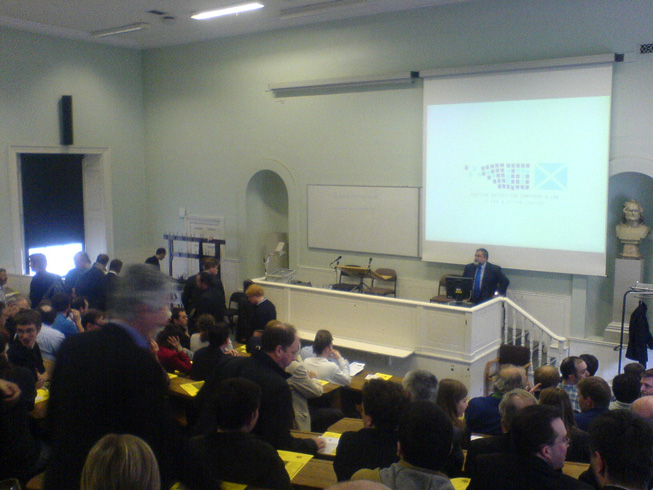
Last night I attended Professor Eben Moglen's lecture at the School of Law at the University of Edinburgh, organised by the Scottish branch of the Society for Computer and Law. The first thing I noticed was that that the audience present in the lecture theatre was starkly divided between the suits and the t-shirts, a shallow observation perhaps, but one that conveys the profound difference of the way one looks at software. As I was explaining to someone before the talk who was unfamiliar with the topic, the t-shirts were there because they believe in free software, while some of the suits were there because they cannot afford to ignore free software and free licensing. The talk is about the GPL version 3.

The lecture started with a compelling look at the ethical imperatives in the sharing of knowledge, "we are one generation away from the free spread of knowledge" through digital means with little or no replication cost. Money is still needed to represent and create knowledge, but such things are becoming cheaper to reproduce. If it is possible to give to each human being anything of utility or beauty at no or little cost, shouldn't we? In the analog economy, cost, labour and the expense of creation generated an economy of property, economists explained why the prior system worked, and why it was wrong. However, nowadays, ignorance and deprivation are preventable, so why do they persist?

Richard Stallman began his movement with a clear moral statement. He had a moral insight regarding software, about rights to use, understand and know about the software. The result of such ideals is the Free Software Foundation. It allows software to get done, it also empowers communities to share their work. GPL v1 and v2 were drafted and released before 1991, but they are just the starting point of the philosophies expounded. The initial rules for sharing assumed that copyright only had to be considered, and therefore the GPL v2 only takes copyright law into account through the inception of copyleft and other legal hacks. But the change brought about by proprietary software has changed the environment, these systems became monopolies, and as every monopoly in history, it creates lousy products at high prices.

Such evolution has required the re-drafting of the GPL, the fundamental legal mechanisms require an update, which has been done by a global process of assembling a physical and virtual community for such purposes. Moglen keeps referring to this as a legislative process, which is an interesting choice of words, but it is precisely intended, as he has been known to have made statements that the GPL is the global norm of the free software movement. The legislative process has been achieved by allowing the community to work freely with itself. The consultation included hackers, industry, lawyers and users. A lot of the useless legislative behaviour was skipped, such as people trying to buy, coerce or scare Stallman. Professor Moglen admitted that the end result is a bit too long and a bit too complex, which is to be expected of such a long consultation.

A persuasive discourse follows on the creation of new law, with some clever snide remarks at Civil Law systems maintaining Roman Law institutions to this day ("norms that were created to sustain 1st century Mediterranean commerce"), and proposes the American Uniform Commercial Code (UCC) as an example of vigorous new norm-making, and that the new GPL is very much akin to the new UCC. But the GPL goes beyond that, it is law-making by the common man, by the community, by the people, in a way that is not done any more. There is a veiled attack on the lawyers in the room by the mention of paid spies (ouch!). There is some mention of the Web 2.0 revolution, that the people's empowerment may herald a new political era. The GPL improved copyright law, which was the law of the publisher. Free software is the law of the creator. The fate of the monopoly will be decided in the next few weeks and months, and the talk ends with rhetoric that resembles "we shall prevail" language.

To me, the other big news from the lecture is that the GPL v3 consensus draft will be released on Friday!

Questions: A question about the interaction between v2 an v3 brings about the quote of the night: "The moment we released the first GPL version 3 draft, version 2 became perfect". He acknowledges that some developers will decide to stay with version 2 (explicitly acknowledging Linus Torvalds very outspoken refusal to migrate), but that this will be a question for each project.

Yours truly then asked the following question: "One of the most controversial elements of the draft version has been the inclusion of technological protection measures in the draft. Seeing that DRMs may fall by their own weight and by their defective nature, wouldn't it have been wiser not to include them?" Moglen answers that having the debate itself was useful, he agrees that TPMs are on the way out, but he argues that this is in part due to the fact that they were included in the draft in the first place. I see his point that the discussion was useful, but I'm not at all sure that DRMs would not be under siege as they are if they had not been mentioned in the proposed text. Hubris anyone?

Media: There will be a video of the talk available from here. Watch this space.

Verdict: The talk was about moral imperatives, and I see why the argument is so persuasive to those who have heard it before. I may be misreading the crowd, but there was a respectful hush throughout. Moglen is a powerful speaker, make no mistake.

Tuesday, June 26, 2007

... and the winner is ....


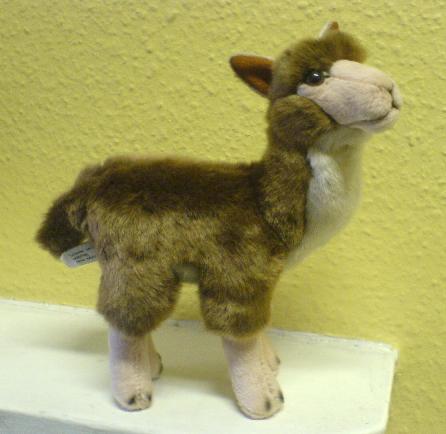
I thought that the best judge for the llama competition had to be Linda's daughter Bethany, who chose the llama in the first place. The winner is Lilian (funny, I didn't think it was female).

In an executive decision, I've decided to call it Lillian to differentiate it with the inimitable original.

Monday, June 25, 2007

New aggregated blog

As part of the synergy generated in the iCommons summit, several Latin American leads suggested the creation of a new aggregated blog bringing together voices talking about open content, CC and other related topics. Thanks to Katitza Rodríguez from CC-Peru we now have a new blog. If you would like to aggregate your content to the blog, please send me an email.

Saturday, June 23, 2007

Friday, June 22, 2007

EMI's sales soar without DRM


There seems to be nothing better than the content and smug feeling you get by saying "we told you so". Well, we did, and it seems clear that the technical protection measure experiment may have finally crashed (henceforth DRM). Several sites report what every person even mildly clued-in to the music scene already knew, that EMI's music has experienced noticeable gains with iTunes Plus service.

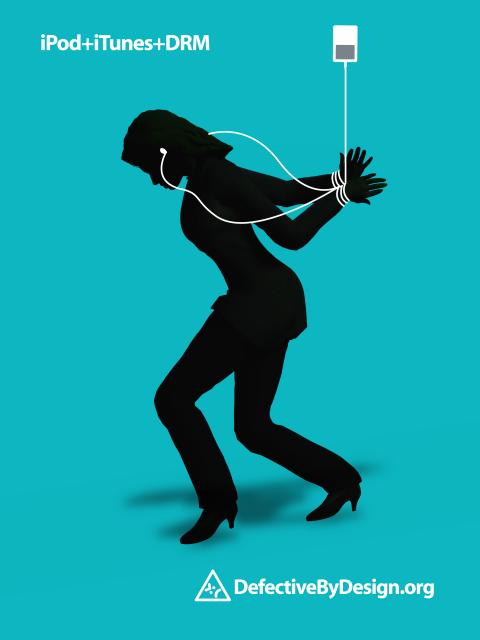
Common sense prevails (I'm sceptical about the argument from common sense, but please indulge me this time). Most people who love music want, at one point in their lives, to be able to reward those artists that make them feel good. This reward can take all sorts of shapes, from buying a CD to buying the lead guitarist a drink when they are at the bar after a gig, and patting them in the back and saying "well done mate". DRM is not one of those natural and moral reward mechanisms. DRM sends a clear message to the fan, it says "we think you're a thief, we only want your money, go away". We want to do all sorts of things with the music, including sharing it with friends and family from time to time. DRM stops us from doing that.

I will continue to buy DRM-free music from iTunes, and if enough of us do, I think that other companies may follow.

Thursday, June 21, 2007

Name the llama shortlist

Thanks to all who sent in entries. There are three short-listed entries:

  • Lilian
  • Dougal
  • Bruno
The winner shall be announced shortly, I'm trying to negotiate a judge.

Wednesday, June 20, 2007

The life of a Chinese gold farmer

(via Colin Miller) As part of my growing interest in virtual economies, here is an eye-opening look at the gold of Chinese gold farmers from Julian Dibbell, including some video footage of their virtual sweat shops (you can sort of smell that the term could be quite literal as well).

Dibbell nails the point that this is probably little different to the conditions found in other sweat shops in China, but that the product still shocks us because these people are hired to play games and produce virtual goods with real monetary value.

I know that this may be a shallow point to make (nobody has ever accused me of depth to the best of my knowledge), but I wonder if there's anyone out there willing to pay me for the many hours spent gaming in front of my computer?

Peer to Patent live

The amazing Peer to Patent system is now live. The system is the creation of New York Law School Professor Beth Noveck, and it is an extremely interesting system of involving the online community on the review of patent claims in pending patent applications.

I believe this is an interesting exercise for many reasons, and it will hopefully help in helping the USPTO in getting its act together and cleaning up its woeful patent quality record.